Monday, August 13, 2012

From Cy Young to Mariano Rivera

The Nobel Prize

Awards are, in their simplest forms, acknowledgments of an achievement.  Meritocratic societies judge members of the collective on certain skills that are deemed important to the group.  As a global society, we have decided that the areas of Physics, Chemistry, Literature, Peace, Economics, and Medicine to be of highest importance.  Thus, those who demonstrate incredible skill, talent, dedication, and proven results in these categories receive illustrious awards known as Nobel Prizes, distinguishing them from all others who participate in the marketplace of ideas and more specifically, in the fields mentioned above. 

Sports, like Physics, Chemistry, Medicine, Literature, and the rest, cannot be described as anything other than meritocratic. In every game a winner emerges and a loser lives to play another day, but no matter what the results, one team or player always rises above the rest, claiming the title, “the best.”  Because sports often involve both team and individual activities, we recognize the feats of both groups.  Team awards are commonly seen as more glorious, thus these awards are the pinnacles of team sports.  In Baseball the team that wins the World Series remains champions for a full season, an honor in itself.  The team wins the most prestigious trophy, and of course, the recognition from everyone associated with the sport.

The Cy Young Award
Although team awards constitute the greatest of all accomplishments, individual awards also matter a great deal.  These awards consist of the Most Valuable Player Award, the Cy Young Award, Golden Gloves, Silver Sluggers, and All-Star game appearances.  Each accolade comes with it’s own set of idiosyncrasies, but I want to focus on the Cy Young Award.

First given out in in 1956, one year after the death of the award’s namesake, Cy Young.  Originally the award was given to the best pitcher in the Major Leagues, but after 1967, Major League Baseball decided to choose a winner in each league, one for the National League and one in the American League.  The Baseball Writers Association of America votes on the winner of the award.  The winner is dubbed the “Baseball’s best regular season pitcher.”  Obviously, this implies that any pitching performed in the playoffs is not considered when choosing the Cy Young Award winners. 

 Recently, I have heard and read speculation that this years National League recipient of this illustrious award should be one of two relief pitchers.  Aroldis Chapman of the Cincinnati Reds and Craig Kimbrel of the Atlanta Braves.  Both pitchers are relief pitchers, specifically known as closers.  Their job is to come in the game in the 9th inning when their team has a lead, but no more than a 4-run lead, and get the final three outs to ensure a win.  Although my opinion of the whole structure of the modern bullpen is biased towards getting rid of the entire construct, I still believe that considering bullpen pitchers for the Cy Young Award to be ludicrous.

Closers compile a statistic that no other player does, due to the situation in the game in which they play, known as the save.  The full definition of what constitutes a save can be found here: “The Save” Saves do not mean very much when appraising a pitcher, due to the variability with which a pitcher can attain a save.  Oftentimes closers will pitch in the most high-pressure situations.  Imagine this.  Your team clings to a modest 2-run lead against your arch nemesis.  The game has been grueling, with both teams putting forth great amounts of effort.  The 9th and final inning comes about and with your team in the lead you bring in your best relief pitcher to get the final three outs.  He comes into the game and must face the opposing team’s three most ferocious hitters, batters who strike fear in the average pitcher, and players who have already displayed their hitting prowess by belting numerous hits throughout the game.

I don’t know about you, but that seems like a pressured-filled situation to me.  I would want a pitcher in the game who could get three outs without allowing a batter to reach first base safely, let alone put the ball in play.  Pitchers who can rack up the strikeouts are often closers, and thus pitch in these situations. 

Kimbrel
Chapman
Now, here is a different situation.  Your team is playing the last place team in the league.  You have a 3-run lead going into the 9th inning, and scheduled to hit are the 7-8-9 hitters for the opposing team.  These three batters barely produce any positive results no matter who stands opposite them on the pitching mound.  This situation lacks the depth and tension that coursed throughout the 1st scenario.  A pitcher who ends the game in this situation receives a save equivalent to the one received if he finishes the first game. 

Saves are not good evaluators of value or even effectiveness.  They show that a pitcher is able to thrive given very specific conditions, but does not distinguish between the numerous other variables that can have a great effect on the impressiveness of the situation. 

So, Saves aren’t as amazing as pundits and coaches often think.  Surely other statistics exist that can prove that relief pitchers are worthy of the Cy Young Award.  The issue with every other statistic is that the Baseball Writer’s Association evaluates starting pitchers on the same statistics.  The major difference between starters and relievers is innings pitched.  I think that we, as fans and observers, can agree that given a larger sample size we can draw more definitive conclusions.  Innings pitched constitute the sample size for a pitcher.  If starters have more innings pitched, than we have a clearer picture into their true value and thus can better determine who is the “best pitcher in baseball.” 

Here are some statistics of crucial statistical categories used to analyze a pitcher’s performance: 
Saves
ERA
WHIP
K/9
Chapman
28
1.26
0.68
16.74
Kimbrel
31
1.26
0.65
15.7
SO/BB
FIP
fWAR
Innings Pitched
Chapman
7.57
1.01
3.2
57
Kimbrel
6.82
0.98
2.3
43

Wins
ERA
WHIP
K/9
Cueto
15
2.72
1.16
9.2
Dickey
15
2.45
1
7.07
Gonzalez
14
3.32
1.14
9.83
SO/BB
FIP
fWAR
Innings Pitched
Cueto
3.43
2.88
4.1
162.1
Dickey
4.61
3.04
4.1
161.2
Gonzalez
2.85
2.7
4.1
141

In the second of the two charts I utilized the statistics of the three top starting pitchers in the National League, Johnny Cueto of the Reds, R.A. Dickey of the Mets, and Gio Gonzalez of the Nationals.  I highlighted some particularly important statistics in red.  As you can see, all three starting pitchers’ innings pitched (our sample size) dwarf those of their relief counterparts.  Chapman and Kimbrel obviously thrive at their jobs.  With K/9 rates both higher than 15.00, these two relievers barely allow the ball to be put in play. Even more so, they do not allow many base runners, as their WHIPS perfectly indicate. 

When calculating the statistic Wins Above Replacement, innings pitched plays a vital role.  The stat is a value statistic, thus it encompasses many of the crucial aspects of, in this case, pitching.  On www.fangraphs.com, the site from which I took this data, Chapman and Kimbrel do not even qualify for the category of WAR unless you remove the restriction of a specific number of innings pitched.  Even so, all three starting pitchers mentioned, have higher WARs than Chapman and Kimbrel.

The idea of considering these two closers for the Cy Young award should be discarded as soon as possible.  The two major reasons given when considering these two pitchers for the award are that no other starting pitcher is having an outstanding enough year to distance themselves from other pitchers, and that both Chapman and Kimbrel are having historic seasons.  I can’t deny these are not true, but I can tell you that they do not and should not matter when discussing who should win the award for best pitcher. 

Just because the decision on who wins this award will be difficult, does not imply that we need to start looking outside of the box for an answer.  Trust me, this is way outside of the box.  Oh, relievers have won the Cy Young in the past, but very few of them actually deserved it.  If you read the article I linked concerning the rules governing a save, you might have noticed that a pitcher can attain a save by pitching the last three innings of a game in which their team is winning.  The number of runs separating the teams plays almost no significance other than that the pitcher’s team in question must be winning the whole time.  Find me a relief pitcher who has accrued as many saves as Kimbrel and Chapman, but did so by throwing three innings at least most of the time, and I would consider them for the Cy Young Award. 

www.baseball-reference.com, calculates a pitcher’s performance in difference situations in a game.  They dub a specific type of situation a high leverage situation.  In my opinion, even a closer who pitches only in these high leverage situations but still throws a third of the number of innings that a starting pitcher does remains undeserving of the Cy Young Award.  This has yet to happen, and might make me think twice about just giving the award to a starter, but in the end, it would not sway my opinion.  Innings pitched, a true sample size, constitutes too much importance. 

The Great Mariano Rivera
My attitude in this situation seems quite closed minded.  Under no circumstance, even a clearly hypothetical one, will I consider a relief pitcher for the Cy Young.  That seems a bit unfair.  Given that the modern bullpen schematic seems fairly permanent, I think we should create a separate award for the best relief pitcher in baseball.  We can call it the Mariano Rivera Award, named after the hands-down best relief pitcher ever to take the mound.  Rivera has never won a Cy Young Award.   

This season I would give the Mariano Rivera Award to either Aroldis Chapman or Craig Kimbrel.  They demonstrate incredible relief statistics and both deserve to be considered for this hypothetical accolade.  I don’t know exactly who should win the Cy Young Award, but it should be a starting pitcher, not a relief pitcher.  Should we change the award to mean the best starting pitcher in baseball? Yes, we should, and simultaneously we should respect the specialization of the game and create the Mariano Rivera Award. 

In a true meritocracy, we shine a light on the best.  In this case, we do not need to reconsider who qualifies for a specific award as much as we should consider expanding the entire awards process to include another prize.   

Wednesday, August 8, 2012

Synchronized Baseball: The Double Play

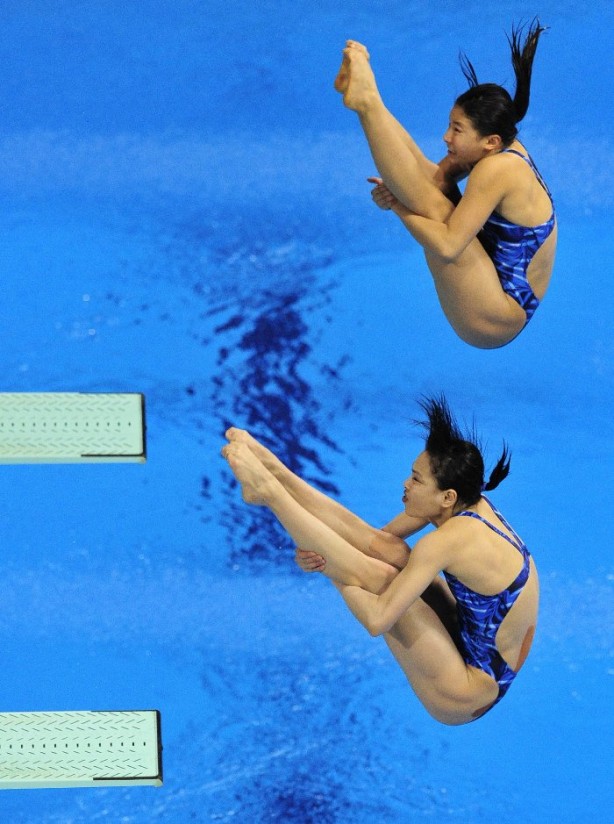
Chinese Olympic Synchronized Divers

Within the last week fans around the world have been dazzled by the 2012 Summer Olympics in London, England.  Unlike professional sports, Olympians work hard and train relentlessly for the euphoric, yet hypothetical moment when they might be named the top athlete of their sport in the world.  Professional sports and Olympic athletic events often clash in that many professional leagues do not allow all of their athletes to compete in the Olympic games. Overall, most fans watch the Olympics for those sports that are rarely spoken of in common sports vernacular.  One of those sports with which I have become enamored is synchronized diving.  Synchronized diving?!! Yes, yes, I'm speaking of the sport in which a pair of men or women, propel themselves, sometimes from extreme heights, contort themselves, and perform flips in mid-air before they comfortably land in the water.  Oh, and by the way, the two athletes are supposed to perform the same dive at exactly the same time.  A perfect dive is not only executed well, but should appear as though one diver is performing the feat in a mirror.

Judges base their scores on execution and synchronization.  This caused me to wonder if there were any similarities between synchronized diving and baseball.  Not long after posing this question to myself I found the answer.  The double play.  Double plays, like many defensive plays in baseball, involve two key attributes, physical ability and baseball intelligence.


The 6-4-3 Variety

Double plays constitute some of the most beautiful and elegant plays in the game of baseball.  Double plays occur quite often, in fact, pitchers will change their strategies when a runner is on-base in order to induce a ground ball to result in a twin killing.  Double plays, like jeans, come in all shapes and sizes.  Common double plays include the 6-4-3, the 4-6-3, the 5-4-3, and the 3-6-3.  The most commonly involved players are the shortstop, second baseman, and first baseman.  Double plays, unlike most other defensive plays in baseball, involve a tandem of players who must prepare mentally and strategically, and then work together to physically carry out their intended task.

Just like the judges in an Olympic synchronized diving competition, we often grade the participants of a double play in two categories, mental preparation and execution.  In addition, the execution of an Olympic dive is partially graded based upon the difficulty of the dive.  This concept also applies to the double play.  Not all double plays are created equal.  Most baseball aficionados would consider a conventional double play one where a ground ball is hit directly at the shortstop.  He fields it cleanly, throwing the ball to the second baseman who has already occupied second base.  The second baseman catches the ball before the runner slides into the base, and throws a strike to the first baseman, thus achieving two outs in one play.

There is no way around it—double plays are a defensive goal and devastating to the offense.  This season, the team that has collectively grounded into the most double plays is the Minnesota Twins.  Not surprisingly the Twins also lead the major leagues in ground balls hit.  The Twins play in a pitcher/defense-oriented park, don't have a great offense, and have a number of fast players who would consistently hit the ball on the ground.

How about the other side?  I could not find a website that tracked the team that caused the most double play situations, but in lieu of that the baseball world uses a pitcher's ground ball percentage.  The pitcher with the highest GB% this season with a minimum of 70 innings pitched is Arizona Diamondbacks right-hander Trevor Cahill with a 61% ground ball percentage.  The team with the highest ground ball percentage thus far in 2012 is the St. Louis Cardinals at 48.9%.  More double plays have occurred this season in the 6th inning than any other, while the fewest double plays have occurred in the 9th inning.  In addition, more double plays occurred in high leverage situations than any other.  Finally, pitchers created the most double plays this season in a no-ball one-strike count.


Sometimes double plays are quite odd.  This 4-2-1 double play occurred in a game between the Red Sox and the Rays in 2010 (Video).  Not all double plays involve only infielders.  For example, an outfielder may catch a fly ball, and consequently throw out a runner attempting to tag up.  Check out Rick Ankiel catching a fly ball in center field and throwing out a runner at third base, completing the 8-5 double play (Video).  Like many of the Olympic events, including synchronized diving, double plays often require athletic prowess.  In order to avoid a base runner sliding into them, and thus breaking up the double play, shortstops will often jump over the incoming runner and throw simultaneously to first base.

Gold Glove
Turning a double play is a crafty business.  Coaches position players in specific spots, including the positioning of the shortstop and second baseman at "double play depth," in order to help the players turn a double play.  Once a player is positioned correctly, the athleticism and split-second decision-making must kick in.  Oftentimes players need to know the circumstances when a double play would not be strategic.  Sometimes players will err when trying to complete a twin killing due to a level of extreme difficulty.  Note that errors are not awarded to fielders because in baseball, you can never assume a double play.  Even when a double play seems imminent and it looks like the fielder erred, he does not receive an error.  Instead, the play is scored as a fielder's choice.

Gold Medal

Double plays are a huge part of a baseball game.  Sometimes they go around-the-horn (5-4-3), while other times they move all over the infield, as in my favorite double play, the 1-2-3 variety.  The ability to complete a double play will often change the strategy of one or both of the managers.  Certain pitchers with abilities to produce ground balls are called upon in situations when a double play is likely to occur.  Overall, one thing is certain: the ability to get two outs in one play is invaluable.  It is comparable to going to the grocery store to buy laundry detergent and seeing that there is a buy-one-get-one free sale.  In sum, double plays are elegant, difficult to execute, and require team coordination, attributes that make the double play oddly similar to a synchronized dive.  Although the fielders do not win gold medals, double plays do help them win gold gloves.    

Saturday, July 28, 2012

It's All In Your Head

Do the dates July 24th - July 31st mean anything to you?  They may signify a long needed vacation, an upcoming heat wave, or an important business trip to a foreign destination.  For those in Major League Baseball, this is the week leading up to the trade deadline.  July 31st marks the official non-waiver trade deadline in Major League baseball.  Once August begins, 2 months remain in the regular season, thus the league decides to restrict the trading of players at a specific point in the second half of the season.  This deadline allows teams to improve prior to the deadline and focus on playing instead or wondering if they may lose of gain a teammate.

During this frenzy of rumors, proposals, and deals, pundits, commentators, and especially fans forget about the affects trades have on the players.  During this part of the summer, front offices play the part of CIA analysts dissecting mountains of information, scouts perform necessary reconnaissance of prospects, and general managers play the role of, well, general.  If these groups execute their jobs properly trades are made, teams looking for playoff berths make improvements, and those wistfully far from the post-season build for the future.

In my opinion, the most recent successful and crafty teams have been the Tampa Bay Rays, Toronto Blue Jays, Atlanta Braves, San Francisco Giants, and Texas Rangers.  These teams usually find themselves as serious buyers and sellers around the trade deadline as opposed to the off-season when free-agency is the main focus.  Mid-level or poorer teams usually relinquish players to free-agency, but during the week leading up to the trade deadline, they make more noise due to their ability to afford players received in trades even if they cannot pony up enough money to sign them to long-term contracts.  To put it a better way, the week leading up to July 31st is a free-for-all.

Instead of focusing on who may be dealt and which prospect will be moved, I want to discuss a less touched upon but vital issue embedded within the cacophony of chatter.  How do trades affect players? Physically nothing changes but their uniforms, but mentally and strategically, everything changes.

Michael Bourn
Strategically, a player traded usually moves from a bad team to a good team.  Take Michael Bourn as an example from 2011.  Bourn played most of the 2011 season with the Houston Astros, but as the deadline approached the pathetic Astros traded their speedy center fielder to the Atlanta Braves in exchange for some major league ready young players and other prospects.  Bourn's preparation for every game shouldn't change too much, except that he will face more National League East pitching instead of Central division pitching.  Instead of the meager 2011 Pirates, Cubs, and Reds pitching staffs, Bourn needed to get ready for the likes of Roy Halladay, Cliff Lee, Cole Hamels, Jordan Zimmerman, and Anibal Sanchez.  This represents a minor strategic shift.

C.C. Sabathia
An example of a greater change in strategy due to trade is typified in a trade made between the Cleveland Indians and Milwaukee Brewers in 2008.  The Indians, in no way bound for the playoffs, traded ace lefty C.C. Sabathia to the Brewers in exchange for Matt LaPorta and other prospects.  Sabathia went from the AL Central to the NL Central.  He would now prepare for many hitters he had never faced in his career, in addition to needing to prepare to hit with no designated hitter rule in the NL.  Sabathia, like Bourn in 2011, both showed their professionalism and talent by producing very well after switching teams.

Bourn
Sabathia
Team
Astros
Braves
Team
Indians
Brewers
Avg.
0.30
0.28
rWAR
1.70
4.70
OPS
0.77
0.67
ERA
3.83
1.65
rWAR
2.10
0.90
WHIP
1.23
1.00
Stolen Bases
39
22
FIP
3.41
2.44


So, the strategic differences involved in trades do not affect players performance to a significant extent.  That leaves the psychological challenges involved in the switching of teams.  A player's team is an affiliation.  Each player has a contract that states that in exchange for services of playing baseball the player is given an annual salary.  This contract goes beyond a piece of paper, and provides a player with camaraderie and allegiance.  Each player's fellow teammates represent their second family.  According to two sports psychology studies,

The effects of changing teams on the performance of major league baseball players
Nicholson, Craig; McTeer, William;White, Philip
Journal of Sport Behavior; Mar 1998; 21, 1; ProQuest  


AND

Pers Soc Psychol Bull 1988 14: 46
Jeffrey M. Jackson, Stephen A. Buglione and David S. Glenwick
A Drive Theory Analysis
Major League Baseball Performance as a Function of Being Traded

players traded mid-season find it difficult to cope with the idea that their former team did not want them anymore.  Often times players who feel this loss will compare themselves to the bounty corralled by their former team, a mistake because often these players are prospects who are unknown commodities.  

While some players find it difficult to leave their former teams, others find psychological issues in attempting to meet or exceed the expectations placed on them by their new squad.  Fans often see a new acquisition as the key to winning and thus place lots of pressure on these new members of their team. In doing so, player will find it difficult in acclimating to their new team.  According to these articles, this is usually not the case.  More often than not players use the stress or expectations placed upon them as a challenge.  Increases in batting average and slugging percentage were seen amongst hitters after switching teams mid-season, while pitchers saw a slight decrease in productivity, but not a to a significant extent.  

So, overall, the psychological effects of mid-season trades are positive, not negative.  Players tend to outperform their statistics from the first half of the season in an attempt to exceed the expectations placed on them and sometimes because they needed a change of scenery.  Sometimes a player's family plays a part in trades.  Cubs pitcher Ryan Dempster, who has the right to reject any trade in which he is involved, recently rejected a trade to the Atlanta Braves.  He did so not because he wishes to remain in Chicago, but due to his desire to be traded to the Los Angeles Dodgers because Los Angeles is closer to his family's home in Vancouver, Canada.  Most players do not have no-trade clauses in their contracts, and thus teams freely trade them to which ever team offers the best package in return.  


Ichiro, Playing Against His Former Team
Trading is risky business, not only for the organizations involved, but for the players psyches and performance.  For team's giving up solid prospects to attain a player they think will propel their squad to the playoffs, it is important to make the transition as smooth as possible.  For example, Ichiro Suzuki recently left Seattle for the Yankees after 11 and a half season with the Mariners.  This transition is not easy, but I'm sure the Yankees made sure to have all of the necessary accommodations to make the transition as easy as a spicy tuna roll (or is it pie?).  Overall, make sure, as a fan, to remember that MLB players are people, and just like being transferred from one part of a company to another affects your life, so do trades affect Major Leaguers.  

Tuesday, July 24, 2012

The Marlin or the Trout

In the 2010 movie The Social Network, Sean Parker proclaims some sage advice on the future of Facebook.   He said, in the words of Aaron Sorkin's award winning script, "When you go fishing you can catch a lot of fish, or you can catch a big fish. You ever walk into a guy's den and see a picture of him standing next to fourteen trout?" Apart from the obvious aquamarine references, this vignette perfectly depicts the current mindset of the Miami Marlins.  

Last night, while watching MLB Network's coverage of the two latest major trades, Ken Rosenthal claimed that the Marlins are looking to sell a number of their talented players in order to build a core if different and younger players.  The Marlins hopes for making the playoffs continue to dwindle as they find themselves 10 games back of the Washington Nationals in the National League East and 7.5 games back in the wild card hunt.  The Marlins, like every team want to catch the big fish, a world series trophy.  This franchise knows how to accomplish this goal, as the have won the same number of world series in the 19 years of the franchise has existed, as the Philadelphia Phillies have won in their 122 years of existence.  

In the past, the Marlins have built a winning team by cultivating young, talented, and most importantly, cheap players through the draft and trades.  They bring these youngster up to the Major Leagues, allowing them to "get their feet (or fins) wet" and gain some experience.  Then, as if struck by lightning, management decides that "this year" is the year to win.  Next, the front office makes a few brilliant and strategic trades to bring in some veteran players to fill the gaps.  Between the young talent and experienced veterans, the Marlins manage to win the wild card, and bing, bang, boom they win the World Series.  This series of events has already occurred twice in less than 20 years, and still the Marlins find it difficult to fill their stadium on a nightly basis.  Oh, and don't forget that after winning the World Series, Marlins management proceeds to trade off all of their talent in order to, once again, plant their farm system with seeds of young prospects.

After years of radio silence in the off season free-agent market, the Marlins finally made a splash.  An organization notorious for never spending a dime, put it's money to good use by snatching up free-agent shortstop Jose Reyes, righty closer Heath Bell, and lefty Mark Buehrle (whose last name I would continuously mispel if not for spell check).  These additions, and a beautiful new retractable roof stadium, were supposed to attract hoards of fans to come roaring through the ticket gates and bring in much needed revenue.  The fish even made a trade for veteran Carlos Lee in the hopes he could help them to the promised land, but El Caballo could not right this forlorn team.  Unfortunately, possibly by not sticking to the old yet proven method of winning, the Marlins find themselves below .500, and barely clinging to the hope that they will turn it around.  

In lieu of this disappointing season, the Marlins seem to be taking, not the road less traveled nor the road most frequented, but a middle path.  A number of, still young, and highly talented players remain on the Marlins squad.  Many of these players came up through their farm system or were traded to Miami just as their Major League careers began.  Yesterday, the Marlins traded right-handed pitcher Anibal Sanchez and second baseman Omar Infante to the Detroit Tigers for a package of prospects including coveted righty Jacob Turner.  This move, in addition to rumors currently swirling, show that the Marlins are not shopping for veteran talent to complement young stars, but instead searching for young talent to partner with their newly acquired veteran free-agents.  

Anibal Sanchez, Hanely Ramirez, Josh Johnson, and Ricky Nolasco are all considered prize assets on the open market, and it seems as though the Marlins are willing to sell.  If the combination of Sanchez and Omar Infante could fetch a package deal including Jacob Turner and Rob Brantly, I can only imagine what the Marlins could get by dangling Ramirez and Johnson as bait.  Nolasco is an interesting prize as well, due to his consistency and proven ability to keep right handed batters from reaching base (.296 OBP against vs righties in his career).  Nolasco is under club control for 2013, which means any team trading for him would be trading for at least a year and a half of service, a more valuable commodity than a half-year rental.   

It isn't often we see underachieving, yet talented, teams such as the 2012 Marlins looking to trade some of their better assets in order to put together a team that could win over a longer stretch of time.  Usually such teams put all of their efforts into righting the ship by buying and not selling at the deadline.  Teams like the Boston Red Sox, Cleveland Indians, and St. Louis Cardinals fall into that category in 2012, but those three squads have been linked to buying, not selling.  I commend the Marlins for their strategy, although it must be easier to pursue such a game plan when the team only ranks 18th in attendance after building a totally new stadium (See http://espn.go.com/mlb/attendance for more information)  

Nolasco is a nice trade piece, as is Heath Bell, and the talented yet enigmatic Hanley Ramirez, but the true prize is Josh Johnson.  Johnson has a year left on his current contract, and despite recent injuries and struggles, has bounced back this season.  Baseball Prospectus predicts he will finish the year with a 2.8 WARP.  More importantly, according to BP's 10 year predictor metrics, the team that possesses Johnson can expect a >3.0 WARP pitcher through the 2018 season.  His upside is undeniable and with Rangers, Angels, and Red Sox scouts reported to be at his most recent strong start, there exists proof to back up the rumors that the Marlins will trade him by the July 31st trade deadline.  

With a wealth of abundant talent on their current MLB squad, the Marlins can expect the equivalent of stock options in return for the rare jewels in their tank.  These prospects may not become the players the Marlins hope them to be, but some of them will be the fish of the future, a future the Marlins hope will be bright and full of wins.  So, does this spectacle deserve the name fire sale, or is it merely a mirage?  Hanley Ramirez, although a stellar talent, has had attitude problems, and while Josh Johnson has extreme talent, he has been oft injured.  The Marlins have twice outsmarted every other Major League team by sneaking into the playoffs and winning the World Series as a franchise sans money.  Is this the beginning of another shadowy run at a title?  Maybe not this season, but I wouldn't say 2014 is out of the question.  

Thursday, July 19, 2012

Middle Management


A Game of Skill:
Professional football coaches, analysts, scouts, and players often use the term "skill players."  Skill positions include the quarterback, running back, wide receiver, corner back, and safety.   Players at these positions are generally leaner and faster than linemen, and must provide skills such as throwing and catching that their more bulky teammates need not showcase.  What does the term "skill position" or "skill player" have to do with America's summer pastime?  Baseball, like its cousin football, can classify certain positions as needing more adroitness than others.  For argument's sake, no doubt every position in baseball needs skills, talent, and athleticism.Yet, the architects of an MLB roster must place greater emphasis and analytic energy into filling the positions of catcher, shortstop, second base, and centerfield.  One might place pitcher into a similar category, but for the sake of brevity let's reserve that for a separate discussion.  

Looking up the Middle:
Dr. Egon Spengler


To quote Dr. Egon Spengler from the movie Ghostbusters, "What are we talking about here?" Well, doctor, that's a great question.  I, not we, mention skill positions because I argue that they truly matter when forming a winning team.  I mentioned that baseball's skill positions are those that reside up-the-middle.  If one were to stand at home plate and look directly toward centerfield the positions in direct view are classified as the up-the-middle positions.  

No one who has ever played or followed baseball would disagree with the statement "Catchers are uniquely different from any other player on a baseball field."  Catchers have the onerous duty of protecting the most coveted spot on the baseball field, home plate.  They must know everything the pitcher knows, be able to throw out runners attempting to steal a base, perform their role as receiver, and hit at least well enough to remain in the line up on a nightly basis.  

While no position is as multifaceted or has as much responsibility as the catcher, shortstops play an important role as well.  Shortstops must simultaneously cover the most ground and deal with the most plays in the infield.  More righties play baseball than lefties; thus more ground balls are hit to the left side of the field than the right.  In addition, the shortstop must have a stronger and more accurate arm than the second baseman, while also playing an important role in all attempts to steal second base.  Often overlooked but no less important, the shortstop also plays a crucial role in directing and executing cut-offs from the outfield.  This list of responsibilities only covers the defensive tasks required of an MLB shortstop; the offensive duties are vast, but vary from player to player.  Overall, the shortstop is the captain of the infield, and usually constitutes either the top defensive talent or vocal leader on the team.  

Can You Spot the Up-The-Middle Positions?
Second base, while not requiring as many tools as shortstop, has many obligations.  The second baseman combines with the shortstop on double plays, cut-off throws, covering second on stolen base attempts, and most importantly, patroling the right side of the infield.  This last responsibility can become more difficult when the first baseman must cover first base in case of a pick-off attempt.  Speed, quickness, and range, constitute only a few of the necessary tools needed to play second base.

Finally, let's talk center field.  Defensively, the center fielder covers the most ground in the outfield, and must have a good arm in order to throw out runners attempting to reach second or third base.  Communication becomes paramount when playing centerfield as the centerfielder must range towards his counterparts in right and left field often, doing so while hoping to avoid a collision.  Some of the most athletic and talented players ever have roamed centerfield including Willie Mays, Ken Griffey Jr., Joe DiMaggio, Mickey Mantle, and Ty Cobb.  

As in the construction of a skyscraper, a solid foundation is vital.  While every position makes up 1/9 of the starting line up for an MLB team, these 4 position players are less replaceable than the other 4 (recall we have exempted the pitcher).  We speak often of wins above replacement or the value of a replacement player, but rarely, amidst all of this talk of replacement, do we remark that certain positions are not as replaceable as others.  Skill positions require specifically skilled or multi-skilled athletes that are not often found in left field, right field, third base, and first base.  

Often times, when I analyze a team the first thing I look at is the play and statistics of the skill position players.  Think about the best teams in baseball right now.  The Rangers, Angels, Yankees, and Braves all have very good up-the-middle combinations. (For a list of every team's fWAR up-the-middle positions click HERE)  The Rangers have the highest combined fWAR of any catcher, shortstop, second base, center field composite in baseball at 11.1 fWAR.  Josh Hamilton, Elvis Andrus, and Ian Kinsler are all indevidually having solid seasons.  The amalgam of Kinsler and Andrus provide above average to stellar defense up the middle for the Rangers.  Last season Kinsler and Andrus each had a UZR (a defensive metric incorporating a player’s range ) above 7.0, and this season both have been adequate up-the-middle.  While catcher Mike Napoli is experiencing a dip in every offensive category this season, Josh Hamilton's scorching start to the year has statistically made up for the regression of the Texas catcher.  

This chart shows the mean, median, range, and standard deviation of every 2012 up-the-middle position in Major League Baseball using fWAR as the evaluating statistic.


Mean
1.62
1.37
1.37
2.10
6.51
Median
1.4
1.4
1.4
1.9
6.55
Max
5.2
3.6
4.6
6.2
11.1
Min
-0.6
-0.7
-2.1
0.1
1.9
Standard Deviation
1.39
1.01
1.51
1.66
2.36
Turning the Double Play

Using UZR as our defensive metric of choice, the best defensive shortstop in MLB is Brendan Ryan of the Seattle Mariners, and the best second baseman is Robinson Cano of the Yankees.  You may have never heard of Ryan but Cano is a household name. He will compete for American League MVP this year.  Ryan adds little offensively, but due to his defense, he has saved about 14 runs from scoring this year.  That's about twice as many as the second best defensive shortstop in the majors, Starlin Castro of the Chicago Cubs.  Ryan's value comes almost completely from his defense.  Despite being far and away the best defensive shortstop, Ryan has only a 1.7 fWAR which is just above average for all MLB shortstops.  

Center fielders have it all.  They can run, jump, hit for average, hit for power, and play a highly valued skill position.  The best players in MLB in 2012 thus far have been center fielders.  Four out of the top 10 players according to fWAR this year play centerfield.  They are Andrew McCutchen of the Pirates, the Braves Michael Bourn, the Tigers’ Austin Jackson, and Angels rookie sensation Mike Trout.  Ever heard of these guys? If you haven't, I would advise learning about them, because all 4 are now and will be the best overall players in Major League Baseball for years to come.  

Eight years, $160 million dollars.  That is the contract recently signed by Dodgers center fielder Matt Kemp. Orioles center fielder Adam Jones recently signed a 6-year $85.5 million contract and others like B.J. Upton (Rays) and Michael Bourn (Braves) will soon be far wealthier men. Why will these players be paid so much money? Production.  Center fielders not only hit for average and power, but they also play great defense, and steal bases.  These deliverables, performed at a high level, usually lead to large contracts and, occasionally, world domination.  

Two of the best defensive catchers in the majors are Yadier Molina and Carlos Ruiz.  Include Joe Mauer and Buster Posey, and you have just identified a pair of players who have already signed huge contracts, Mauer and Molina, and a pair who will soon demand large sums of money, Ruiz and Posey.  Oftentimes, teams care less about offensive production from their catchers because of the value placed on a catcher's defense.  The four aforementioned catchers all hit well in addition to playing above average defense, and thus, like the center fielders mentioned above, represent some of the most complete players in all of Major League Baseball. 

Making the Big Money

What can we conclude from all of these data? Up-the-middle positions represent the keystone of a baseball team.  The 2012 Arizona Diamondbacks, Philadelphia Phillies, Minnesota Twins, and St. Louis Cardinals all have up-the-middle combined fWARs of 8.2 or above -- at least one standard deviation above the mean -- which proves that these squads will most likely remain competitive this season and have strong foundations on which to build for years to come.  

While up-the-middle position players represent the most complete athletes in baseball, corner outfielders, third baseman, and 1st basemen get much of the publicity and money.  The top 15 largest contracts ever signed in baseball history have been as follows: 

1
Alex Rodriguez
3B
2
Alex Rodriguez 
3B (Contract #2)
3
Albert Pujols
1B
4
Joey Votto
1B
5
Prince Fielder
1B
6
Derek Jeter
SS
7
Joe Mauer
C
8
Mark Texiara
1B
9
C.C. Sabathia
LHP
10
Manny Ramirez
LF
11
Matt Kemp
CF
12
Troy Tulowitzki
SS
13
Adrian Gonzalez
1B
14
Miguel Cabrera
1B/3B
15
Carl Crawford
LF

Nine of the 14 non-pitchers on the list play a corner outfield, 1st or 3rd base.  Interestingly enough, the positions getting the largest contracts are not the same as those with the highest valued players.

In the End:
Whether you are at the ballpark, watching on television, listening on the radio, or checking the scores on the internet, next time you want to evaluate a team about which you know very little, check the players at catcher, 2nd base, shortstop, and centerfield.  If those players are solid, the team may be more formidable on a game-to-game basis than perceived by the general public.