Showing posts with label Detroit Tigers. Show all posts

Friday, February 8, 2013

King of The Hill

Felix Hernandez
Yesterday USA Today reported that the Seattle Mariners and ace pitcher Felix Hernandez have agreed to a 7-year $175 million contact. Felix's previous contract wasn't set to expire for two more seasons, but his new contract doesn't extend on top of those two years, instead it modifies the next two seasons and adds 5 more. The aspect of this news that stands out the most is that Felix Hernandez, at 26 years old, is now the highest paid pitcher of all time. The previous high for AAV for a pitcher was the recently signed Zack Greinke. His contract with the Dodgers was set to pay him $24.5 million annually, but after 2 years of Hernandez's deal, Felix will be receiving $25 million annually.

So, did Felix Hernandez deserve this contract, and if so, why did he sign it, and why did the Mariners offer it? First, Felix deserves to be paid like a top 5 pitcher because his numbers prove it. Felix has played 8 seasons in the Majors, all for the Mariners, coming up as a 19 year old, and immediately began throwing 190+ innings in only his second season in the Majors. Hernandez, like many young ace pitchers, came in throwing in the mid 90's with his fastball, showing sharp breaking balls including a slider with velocities peaking above 90 mph. Comparing heat maps of Hernandez's pitches from early in his career to his most recent seasons shows a move from pitches near the middle of the plate to the corners. Hernandez's does a great job of keeping his pitches low and away to righties and on the inside corner to lefties, the perfect combination for pitching success. This maturity on the mound has shown in King Felix's numbers as well. Due to his improved precision and strategy, Felix's BB/9 has been getting steadily less and less since peaking in 2008. While Hernandez's ground ball percentage has been seeing some attrition, Felix has countered it with an increase in strikeouts while his swing percentage (the total percentage of pitches a batter swings at) has remained constant, showing better control and precisions despite drops in velocity and number of ground balls induced.

Hernandez's statistics have been following the typical age curve for a starting pitcher as constructed by the good people at Fangraphs.com. As you can see, velocity should begin to trend down around age 27, but FIP, BB/9, and K/9 should all remain constant until age 29 or so when the edges begin to fray. This graph is meant to generalize the production of starting pitchers over time, it doesn't take into account that Hernandez, who has huge amounts of talent, may age better than the average or even above-average pitcher. The Mariners weren't completely trusting in Hernandez's ability to age like Greg Maddux, not giving him a 7-year extension, but adding 5 years onto the already guaranteed 2 years from his previous contract. This decision shows that the Mariners understand that even the best pitchers reach stumbling blocks after they turn 31 years old. On the other hand, if there was a pitcher or two I would be counting on performing at a high level will into his thirties, Felix Hernandez is near or at the top of my list. In his career Hernandez has shown an ability to stay healthy and stay on the field. He's thrown over 200 innings 5 of his 8 MLB seasons, from 2008-2012. Hernandez has reaching the disabled list twice in his career, in 2007 and 2008, which isn't unreasonable as his innings work load had just increased dramatically, a change that commonly leads to some arm issues.

Now that I've answered whether Felix Hernandez was worth the money and years in this deal, now let's talk about why King Felix would sign this contract. First, the money is on the table now. Hernandez, like all other athletes know that once their careers in professional sports end their income will fall drastically, so they go for the most money and for financial security whenever they can during their careers. Hernandez had two years remaining on the 5-year $78 million contract he signed in 2010, taking him through his arbitration eligible years. He could have played out those seasons in Seattle and then explored his options, and there would be many, on the free agent market as a 28 year old, but instead Felix resigned with the team that scouting him, drafted him, developed him, and has treated him as well as a team that has won recently can. Seattle has been a team never lacking a franchise player, loved in the city, no matter the Mariners winning percentage. In the 90's the team had Ken Griffey Jr., between 2000 and 2012 it was Ichiro Suzuki, and with this new contract, the torch has officially been passed to Felix Hernandez. Hernandez is loved by the city of Seattle, when he starts at home; Mariners fans in right field count his strikeouts, calling themselves the King's Court. In addition, Seattle, while not New York or Boston, is a fairly metropolitan city, ranking 22nd in population according to the most recent census data.

Another reason for hope in Seattle, and thus another justification for Felix resigning in the Emerald City, is Seattle's incredible group of young talent. ESPN's Keith Law recently ranked Seattle as having the 8th best farm system in the league with a solid core of young starting pitchers like Taijaun Walker, James Paxton, and Danny Hultzen. In addition, they sport a top infield prospect in Nick Franklin, young catching prospect Mike Zunino, and young players already with the big club like Jesus Montero, Michael Saunders, Kyle Seager, and Dustin Ackley. So, maybe the Mariners won't be a winning team this season or even next season, but just around the time Hernandez's AAV goes from $20 to $25 million the Mariners should have the type of team ready to compete for the playoffs. This shows that Hernandez has faith in the Mariners system, and when the face of the franchise shows confidence in the team, the fans won't be far behind.

So, while Felix may have given up a chance to make maybe more money in a bigger city like Boston or Chicago, and might have lessened his chances of winning a World Sereis, there were numerous solid justifications for resigning with the Mariners. So, the only question left to answer is the simplest, why the Mariners would offer Felix a contract of this length and magnitude. The Mariners aren't a big time franchise, but the team has never had a problem spending money on free agents, a la Chone Figgins. In addition, Hernandez will now make up 20% or more of Seattles overall payroll. We've recently seen how big contracts can still force the hands of the richest teams as with the Alex Rodriguez situation with the Yankees. The Mariners may be extending a lot of money to Felix, but as we've already proven, he's worth the money. The Mariners have most of their future success tied up in youth, and you is inexpensive. This paradigm is conducive to having a large portion of the payroll going to one or two players because young players are cheap. Signing Hernandez allows the Mariners to now change their marketing strategy to make King Felix a brand, a name that every citizen of Seattle knows. Given Seattles solid history of rabid fandom and passion for the Mariners, the team will have little trouble anointing Felix Hernandez the next Sultan of Seattle.

Justin Verlander
So, this deal looks good, it benefits the player, the team, and the fans, but what does it mean for the rest of the league? Baseball is a business and in Hernandez's contract changes the landscape of the market just like Zack Greinke's did before this and Cole Hamel's deal did before that. Two of the top 3 pitchers in the league have contracts ending in two years, and without a doubt King Felix's new deal will affect both of their next contracts. Clayton Kershaw, currently 24 years old, and Justin Verlander, currently 29 years old. Verlander has been the best pitcher in Baseball since 2009; he won an MVP and Cy Young award with the Tigers, and has brought them to two World Series. He may get similar AAV to Felix Hernandez, in fact he may get a little more, but he won't get a 7-year deal. At his age a 5-year contract would be the most I would go.

Name Team IP K/9 BB/9 HR/9 ERA FIP WAR
Justin Verlander Tigers 953.2 9.22 2.37 0.73 2.95 2.93 28.6
Felix Hernandez Mariners 954 8.43 2.49 0.61 2.81 3.03 24.2
Zack Greinke - - - 833.1 8.9 2.21 0.71 3.37 2.93 23.5
Clayton Kershaw Dodgers 836.1 9.41 3.11 0.55 2.6 2.87 20.8

Clayton Kershaw
As for Kershaw, Hernandez's contract impacts him greatly. If Kershaw wants an extension now, he could get a deal similar to Hernandez due to his youth and his already stellar career. On the other hand, if Kershaw plays through his current deal becomes a free agent at age 26, Kershaw could sign a contract of similar length to Hernandez but for even more AAV. That would seem like the most lucrative path for Kershaw, but if the native Texan wants to stay with the Dodgers, and like Jared Weaver with the Angels, not want to deal with contract speculation, he could sign an extension now and still get a second huge deal around his age 30 season. Overall, the Dodgers have a lot of money, holes burning in their pockets, and so one way or the other, Kershaw will make a lot of money, most likely in Los Angeles.
So, while $175 million sounds like a huge amount of money, and it is, we now see that the money is justified, for all parties involved. Felix Hernandez and the Seattle Mariners now go hand-in-hand; Felix represents the city, similar to the Mariners greats before him. In 2011 he won the AL Cy Young award, in 2012 he threw a perfect game, now he's the highest paid pitcher of all time, and, as all Mariners fans hope, he will be a World Champion down the road. If there was ever a more perfect road to Cooperstown, I haven't heard of it yet. Now comes the hard part, everything just has to work out. 

Thursday, January 24, 2013

Upton, Upton and Away

Justin Upton
Since June 2012, www.mlbtraderumors.com has put out 30+ articles with the words Justin Upton rumors in the title. This isn't just a blind fasciation with a specific player; the Diamondbacks have done everything but see Upton on the plane out of Phoenix. Arizona hasn't offered Upton an extension or publicly supported him; instead the team has shopped him all over the league hoping to get the best package in return. Upton still has three affordable years left on his current contract, is the ripe young age of 25 years old, and has compiled 17.1 fWins in his 6 MLB seasons, a combination usually destined for stardom. Upton has numerous skills and few deficiencies, and he's entering the most productive years of his career, and now he has a new team.

Justin Upton the Player:

Who is Justin Upton? Over the last few months we've taken to see him as a commodity, and not a player. Maybe familiarizing ourselves with him will give us greater insight into the Diamondbacks' decision to trade him and the Braves' desire to acquire him.

First of all, Upton is 6 foot 2 inches tall and weighs 205 pounds, a prototypical athlete's build. This is something a scout would say, but many well skilled in analytics would say that it isn't indicative of success. Both the scout and the numbers guy are correct. Not all athletic players are great and not all great players are athletic, but players with the combination of athleticism and the numbers to back it up generally make cases for Cooperstown. Upton's build aids in his ability to stay healthy and his raw combination of speed, power, and agility.

Offensively, Upton has had ups and downs in his career, but never a bad season, so we can safely assume that he won't drop off, and that the numbers we have are reliable. From a power hitting perspective, Upton fits the bill as a middle-of-the-order hitter. While Upton's home run totals have ranged from 17 to 31, he has a total of 2 more home runs in his career than fellow young talented outfielder Adam Jones, signifying a high probability that he will continue to pump out somewhere between 20 and 30 home runs per season for the duration of his prime years.
HR ISO SLG
2007 2 0.143 0.364
2008 15 0.213 0.463
2009 26 0.232 0.532
2010 17 0.17 0.442
2011 31 0.24 0.529
2012 17 0.15 0.43


Upton is a right-handed batter, meaning he might have a problem with right-handed pitching, but as you can see from his platoon splits, Upton hits both righty and lefty pitchers fairly equally.  
PLATOON AVG OBP SLG TAv
vs L (Multi) 0.278 0.387 0.480 0.294
vs R (Multi) 0.283 0.349 0.460 0.285
Split (Multi) 0.005 -0.038 -0.02 -0.009
Upton's platoon split numbers show an ability to hit righties and lefties, but it also shows a lack of patience or an inability to see right-handed pitching as opposed to left-handed pitching well. Looking at his BB/K ratio splits, 1.04 vs. LHP and 0.37 vs. RHP, further proves this point. So, Upton goes from being a good hitter against righties to a very good hitter against lefties, typical for right-handed hitters.

Defensively, Upton is suited for his position, corner outfield. Using defensive runs saved and ultimate zone rating, it's fairly obvious that Upton is just above average in right field, to the point that he is a defensive asset in comparison to an average right fielder. Given that the Braves have stud right fielder Jason Heyward patrolling right field, Upton will be moved to left-field, a least demanding outfield position, where his defensive numbers will most-likely improve even more. While defense does begin a descent as players age, Upton is only 25, so moving him to left field won't allow any defensive deficiencies to pop up for the near future. 

Upton also presents as an above average baserunner. He has posted a positive, if not above average UBR in each of his 6 seasons in the league, showing both speed and base running acumen. 
2007BsR
20081.1
20091.5
20103.5
20110.7
20124.5
Justin Upton the Acquisition:
Martin Prado
So, it turns out to be true, Justin Upton is worth the price of a trade, but what about this specific deal with the Braves? The Braves sent 3B/OF Martin Prado, RHP Randall Delgado, SS Nick Ahmed, RHP Zeke Spruill, and 1B/3B and Brandon Drury. Prado has been a great player, in that he is above average defensively at third base, left field, and previously at 2nd base, while posting career .341 wOBA, 111 wRC+, and .345 OBP. Prado makes his living by swinging. He doesn't walk often, career 7.0 BB%, swings a lot, career 90.1 contact percentage, but still produces 11% more offense than a replacement level player. 

Randall Delgado is the swing player in this deal. I say "swing player" because Delgado is on the cusp of becoming a full-time Major League pitcher. Delgado has a great deal of talent and upside given the impressive comments from scouts, but he hasn't replicated his Minor League success in the big leagues just yet. Delgado is 23, so if he is destined to blossom, it should happen within the next 3 seasons. He's cheap, under team control, and has a mid-90's fastball, sinker/change up combination that induces ground balls. On the other hand, he also has issues with his control, posting a 3.95 BB/9 rate in his career. In addition to his high walk rate, Delgado, despite his power four-seamer, posted a 50.2 GB% last season showing a pitcher who isn't going to post high strikeout numbers, but has a power sinker that has serious movement. That serious movement probably causes some of his wildness, so if Diamondbacks pitching coach Charles Nagy can work on keeping Delgado calm on the mound, and confident in his abilities, his walk numbers should come down a bit as the velocity on his fastball comes down. Fausto Carmona went through a similar situation when pitching in Cleveland.

As for the other three players in this deal, all three are prospects. Nick Ahmed is a polished shortstop that does everything well, but isn't exceptional in any category. He plays solid defense, has good speed, makes good contact, but doesn't project as more than a replacement level shortstop. Given most teams' lack of depth in up-the-middle position prospects, Ahmed becomes more valuable than his numbers/skills indicate. Look for the Diamondbacks to either move Ahmed for another pitcher, the rumor mill seems to think the Tigers' Rick Porcello, or to keep him to compete with Didi Gregorius as the future shortstop in Arizona. Spruill is an interesting prospect. He's similar to Delgado, but has no MLB experience under his belt. He's a righty with speed and multiple useable pitches, and has received positive scouting reports noting him as a future #3 type starter. This gives the Diamondbacks 4 young near MLB-ready or MLB-ready pitchers, one more than they had going into the offseason. While Trevor Bauer has the possibility to be a top-15 starting pitcher in the Majors for the next 10 years, Spruill isn't too far off, and he represents only 1/5 of the package the Dbacks received for Upton. 

Who Got the Best Deal:
GM Frank Wren
In this case, I'm going to say that it's a tie. In the short term, the Braves won. In fact, I think the Braves won this deal for the next 3 seasons. Once Upton's current contract expires and he is looking at a contract worth approximately $150 million, the Braves won't be able to afford him. Sure, his brother B.J. is signed on with Atlanta for 5 seasons, but that won't be enough to persuade brother Justin from leaving for the big money.  Upton is a stud, but not a star. Stardom comes with consistency, so when Justin Upton shows true consistency, we can dub him a star, but for now he is just a stud. On the other hand, I would say fellow Braves outfielders Jason Heyward and B.J. Upton are also studs. The Braves look like they traded a lot for Upton, but given his age, and previous experience, Justin is worth it. Oh, and there's the added bonus that the Diamondbacks also sent third baseman Chris Johnson to Atlanta. This is a downgrade from Prado, but when you add Johnson's projected numbers to Upton's projections, then subtract Prado's projections, the Braves have made a serious offensive upgrade. The Braves had to make a move like this if they wanted to have a chance to win the NL East since the Nationals, at least on paper, look to be the favorites to win the east for a second consecutive season. 
Braves Grade: A- (The Braves should continue to draft well, so replenishing the farm system won't be difficult. Given that they made a significant upgrade at a time when they had to in order to compete for the playoffs, makes me like this trade a lot.)

GM Kevin Towers
The Diamondbacks might regret this move for a season or two, but in the long run I expect them to be declared the winners of this deal. Every player they acquired other than Martin Prado is under team control at a cheap price for a minimum of 5 years. That being said, the Diamondbacks are reportedly looking to finalize a contract extension with Prado. In addition, if Kevin Towers moves Ahmed and another piece to Detroit for Rick Porcello, the Diamondbacks will have incredible pitching and outfield depth as well as great young hitters at catcher, 2nd base, and 1st base. The Diamondbacks are a middle market team, meaning they aren't usually blessed with options, yet this franchise is full of them. Towers has given himself flexibility where it counts. Outfielders can switch positions and lend themselves easily to platoon splitting while pitchers are oft-injured, so having a stock piling of players at both positions gives the Diamondbacks enough backup options to keep them contending with the newly strengthen NL West for years to come. The one possible move that some say will happen and some say shouldn't is a trade of Jason Kubel. Kubel provides a great power bat against right-handed pitching as well as a propensity to hit lots of home runs and doubles in the big alleys at Chase Field. In my opinion, the Diamondbacks should keep Kubel, since even the acquisition of Martin Prado doesn't make up for the offense lost with Upton's relocation. 
Diamondbacks Grade: A (They have everything they want, and more importantly, the options to further improve. If Upton becomes the next Hank Aaron Towers will be pissed, but this trade allows the Dbacks to compete in 2013 as well as 2014-2018.

My Grade: A

Saturday, December 15, 2012

Recent Movement: Part II

Free agency and the MLB offseason stop for no one. Following the usually bustling Winter Meetings, numerous free agents have signed with teams and trades have been consummated. In our first installment, I looked at contracts signed by Zack Greinke, Kevin Youkilis, Ichiro Suzuki, and others. In this follow up post I'll look at some of the contracts signed in the last three days including big names like Josh Hamilton and Anibal Sanchez as well as minor ones like Mike Adams and John Lannan. So, without further adieu, let's begin.

Josh Hamilton in Halo Red
LA Angels sign OF Josh Hamilton to a 5-year $125 million contract: With Zack Greinke safely secure in a Dodgers jersey, the next biggest name remaining unsigned until now was Josh Hamilton. According to sources, prior to signing this multi-year deal with the Angels, Hamilton's suitors included the Texas Rangers, Philadelphia Phillies, and Seattle Mariners. Notice how I didn't mention the Angels as a team noted to be interested in Hamilton. No one saw the Angels coming, but LA has a history of swooping in as a mystery team to sign big name free agents. Last offseason Jerry Dipoto and Arte Moreno made a big splash by signing Albert Pujols and C.J. Wilson to multi-year deals. This offseason, the Angels revamped their pitching staff, but no one suspected them of needing another outfielder. Nonetheless, Hamilton is now a halo, staying in the same division, but moving a bit further west.

So, what does Hamilton bring to the table? Hamilton is a top hitter. While in Texas, Hamilton put up great offensive numbers including both power numbers and hitting for average.
wOBA wRC+ HR ISO fWAR
2008 0.384 132 32 0.226 4.1
2009 0.321 85 10 0.158 1.4
2010 0.445 175 32 0.274 8.4
2011 0.369 126 25 0.238 4.1
2012 0.387 140 43 0.292 4.4
As you can see, Hamilton is the prototypical middle of the order hitter, He creates runs at above average rates, hits home runs regularly, and in 4 out of the last 5 seasons he has been an overall offensive juggernaut. In the field, Hamilton has shown to be adequate, posting solid UZR numbers in every season in Texas other than 2012. With the impending move from the more demanding position of center field to a corner outfield spot, Hamilton's defensive numbers should return to above average rates. Hamilton brings the entire package to Los Angeles. The Angels made a bold move here. They are a wealthy team, with major money coming in from a big TV deal, but most though the Angels were done spending after picking up Pujols and Wilson. Instead, Hamilton joins Pujols and Mike Trout as a three-headed monster in the Angels lineup. 

Interestingly, the Angels signing of Hamilton fits well with the other moves the team has made this offseason. The team ridded themselves of the talented underachieving Ervin Santana as well as Dan Haren replacing the two starters with Joe Blanton and Tommy Hanson. Hanson and Blanton are solid innings eaters, but without a solid offense, these two pitchers won't make the difference between Angels wins and losses. Well, with the addition of Hamilton, the Angels added the cog that will help the Angels win games despite average pitching. With Trout, Hamilton, and Pujols making up 3 of the first 4 spots in the Angels batting order, opposing pitchers will have to tread carefully. 

My Grade: A- (Okay, so no one saw this coming, but it actually makes a lot of sense for both the Angels and Hamilton. Hamilton moves away from Texas, but joins a team with one of the best managers in baseball, and most importantly a team willing to give him more than a 4-year contract. Hamilton wanted stability, but most teams saw him as volatile given his off the field problems with substance abuse. The Angels needed another big bat in their lineup to provide value in place of the departing Zack Greinke. It's odd to think that the Angels could replace Greinke's production on the mound with a bat, but value is value, and instead of giving up fewer runs, the Angels are just going to score more. Both lead to more victories.)

Red Sox sign RHP Ryan Dempster to a 2-year $26.5 million contract: You might be asking yourself, do the Red Sox have a thing for players making $13 million AAV? Mike Napoli, Shane Victorino, and now Ryan Dempster will all make ~ $13 million per season over the course of their contracts with the Sox. Victorino and Napoli aside, let's focus on Dempster's recent deal. Dempster is somewhat of a phenomenon in that his career took off after crossing age 30 threshold. Ever since Dempster turned 30, he has posted an average fWAR of 3.6 per season as opposed to an average fWAR of 0.8 in the 5 years prior to turning 30. This portrays a pitcher who has always had talent, but figured it out later in his career. That type of turnaround only comes from someone who has the intelligence to adapt towards falling velocity on his fastball, and the acumen to learn how to fool hitters by locating and mixing up his pitches. PECOTA projects Dempster to put up 1.7 and 1.2 WARP in 2013 and 2014 respectively, making him worth just about the amount of money he will be paid in those years. The Red Sox are definitely not stupid, and whether Dempster ends up becoming a trade candidate at he 2013 deadline or a solid #3 starter for a contending Sox team, Ben Cherington and company can be assured to get a solid value out of Dempster. Dempster gets outs by throwing a hard sinker that has a solid pitch value, enough to consistently get Dempster GB% numbers above 43%. Combine those numbers with a K/9 rate of ~ 8.00, and you've got a pitcher that keeps the ball in the ballpark, but misses plenty of bats as well. As long as Dempster continues to pound the strike zone, keeping his BB/9 low, he should provide the value that PECOTA forecasts he will.
My Grade: B+ (The Red Sox should get solid value out of Dempster, with the key to his deal being the length of the contract, not the dollar amount. If the Red Sox are contenders in 2013, Dempster will surely be a significant component, but if they falter, he would be the perfect trade candidate at the 2013 trade deadline. Most teams in contention would love a right-handed veteran who gets ground balls at a reasonable salary and with one year of control under his belt.)

Anibal Sanchez
Tigers sign RHP Anibal Sanchez to a 5-year $80 million contract: So what do we have here? Every big name free agent on the 2012-2013 market has changed teams. Greinke went from the Angels to the Dodgers, Hamilton switched AL West teams going from Texas to LA, and B.J. Upton moved from Tampa to Atlanta. Finally, a top free agent who decided to stay with his 2012 team for the future. As this article shows, Greinke and Sanchez compare fairly favorably, except that Greinke has shown glimpses of ace status pitching, while Sanchez seems to top out at a #2 starter. Still, Sanchez's new $80 million contract bests C.J. Wilson's deal deal from last offseason, so how did this deal get done? It was reported that the Cubs had offered Sanchez a deal similar to the one Wilson got last season from the Angels, until Sanchez decided to give the Tigers a last shot at besting the Cubs' offer. The Tigers swooped in, and signed Sanchez, effectively stealing him from the Cubs. Sanchez obviously wanted to return to Detroit, but then why would he want to leave? The Tigers are contenders who need Sanchez to solidify their rotation behind Justin Verlander. Sanchez is young (28 years old), durable (3 straight seasons with at least 195 innings pitched), keeps the ball in the park (.92 HR/9 in 2012), and most importantly, projects well in the future. At $16 million AAV, Sanchez will need to continue his > 3 win success in order to justify the money coming his way. Whether he can accomplish this feat is unknown, but given the Tigers' other option, this was probably the best decision for the franchise. 
My Grade: B (A+ for Sanchez seeing as he's probably getting more money than he's worth, but only a C+ for the Tigers. Theoretically they could have spent that money more wisely because Sanchez isn't a sure thing. It'll be interesting to see if Sanchez lives up to this deal, or becomes an overpaid #4 starter.)

Mike Adams
Phillies sign RHP Mike Adams to a 2-year $12 million contract: Ruben Amaro continues to stupefy Phillies fans by making prudent, intelligent, and understated moves. First he traded for Ben Revere instead of paying boatloads of money for Josh Hamilton or Michael Bourn, next he traded for Michael young instead of signing Kevin Youkilis, and now he's making smart decisions to upgrade the bullpen. Mike Adams is about as solid of a bullpen pitcher as is out there. Adams won't blow you away, but he throws a very good cutter and curveball that fool hitters from both sides of the plate, forcing them to hit the ball on the ground, but more importantly keeping the ball in the park. Adams, even in home run friendly Texas, kept his HR/FB % below 8%, which is an incredible feat. Since 2006 only three Texas relievers have kept their HR/FB % below 8%, and they are all considered top of the line relief pitchers (Joaquin Benoit, Neftali Feliz, and Darren Oliver). Adams has been durable, providing an average of ~ 59.0 innings pitcher per season since 2008, doing so in San Diego and Texas. It is important for late inning relievers to be able to pitch in higher-pressure situations, and Adams does just that, posting positive WP/LI numbers in his last 5 seasons as well as a 1.27 clutch in 2012. At age 35, it makes sense that Adams is looking for a veteran team with playoff hopes as well as a multi-year contract. The Phillies must have been thrilled to keep Adam's annual salary to an average of $6 million, willingly giving the righty pen pitcher more than a single year deal. Adding Adams to lefty Antonio Bastardo, righty Philippe Aumont, and closer Jonathan Papelbon makes a lot of sense, and solidifies the Phillies bullpen.
My Grade: A (There is little to be said against this deal. The Phillies aren't paying a lot for a solid late inning reliever with experience, and an inability to give up home runs, which is a must in home run friendly Citizens Bank Park. Adams gets the security of a 2-year deal, something most relievers over the age of 35 get.)

Phillies sign LHP John Lannan to a 1-year $2.5 million contract: Ruben Amaro continues to impress. The Phillies trade of Vance Worley and Trevor May to the Twins in exchange for Ben Revere left the Phillies with a hole in their rotation. This is precisely the hole that the Phillies expect John Lannan to fill. Lannan spent most of his time in triple A last season due to the plethora of pitchers the Nationals had on their roster including Stephen Strasburg, Gio Gonzalez, Edwin Jackson, etc... So, why would the Phillies want a pitcher who couldn't even crack an opening day roster in 2012? Well, John Lannan is a very specific type of pitcher. He, like Mike Adams, keeps the ball in the ballpark, and more importantly keeps the ball on the ground. In his career, Lannan has put up some abysmal strikeout numbers (career 4.71 K/9), but has compensated for his inability to miss bats by posting a career GB% of 53%. While Lannan will give up his share of base runners, with runners on base, he has a 50% ground ball percentage, showing his ability to keep runners from scoring by forcing hitters to ground into double plays. The Phillies have solid up-the-middle defense in the combination of Jimmy Rollins and Chase Utley, a duo that should make Lannan look very good. In looking at a comparison between the departed Worley and Lannan we see a two pitchers who produce similar value but do so in completely different ways. Worley combined solid K/9 rates with good left on base % to keep his ERA down, while Lannan uses the ground ball to get most of his outs. So the equation for this deal is as follows: Ben Revere + John Lannan = Vance Worley + Trevor May. Does this make sense? Well, it probably does. The Phillies have a group of young pitchers all close to being able to compete for the 5th spot in their rotation including Jonathan Pettibone and Brody Colvin, so signing Lannan to fill that spot for one season makes a lot of sense. Here's what PECOTA projects for the Phillies 2013 rotation: 
2013 WARP
Roy Halladay 4.2
Cliff Lee 3.6
Cole Hamels 3.6
John Lannan 0
Kyle Kendrick -0.3
Total 11.1
My Grade: B (Now the Phillies sport three ground ball pitchers in their rotation to go along with strikeout gurus Cole Hamels and Cliff Lee. Lannan is a cheap replacement for Vance Worley, and he's only under contract for one year. For Lannan, this contract means an chance at redemption. A chance to show every team that he can still pitch, and that the Nationals were fools for relegating him to triple A. Citizens Bank park is a home run friendly venue, but doesn't lend itself to lots of other extra base hits, so if Lannan can keep the ball on the ground and in the park, he should perform well in 2013)

The free agent market looks to be shaping up. With Hamilton off of the market it is only a matter of time before Nick Swisher, Cody Ross, and Michael Bourn have new contracts. Multiple teams still need outfielders and those are three very good ones. Pitching-wise, with Greinke and Sanchez signing contracts, teams will begin to scramble to complete their starting rotations with those pitchers left on the market. In my next column, I'll look at the two, and soon to be three big trades made since the end of Baseball's Winter Meetings. 

Wednesday, October 24, 2012

It All Comes Down To This

Tonight it begins. The World Series is the big, flashy, and exciting number that ends the musical that is the Major League Baseball season. In the spring, 29 teams set forth to conquer the baseball world, and one set forth to re-conquer it. The 750 players who began the season on the 25-man rosters of each team clawed tooth and nail, legging out doubles on bloop hits to the outfield, running from left-centerfield all the way to right-center to make a diving catch, and blocking every breaking ball in the dirt in order to attain baseball glory. Unfortunately, for all but 50 this season did not turn out the way they had hoped. Injuries, coaching changes, trades, interviews gone wrong, hanging breaking balls, mental errors, and of course randomness caused 28 teams to falter, and only two to prevail.

The Detroit Tigers and San Francisco Giants will begin the 2012 World Series tonight in the chilly city by the bay to duke it out for the right to be crowned 2012 champions. So, there is little left to do but evaluate the two teams, and pick a winner, knowing that the chances of the series playing out like any of us think it will is ludicrous. Let's go step-by-step, and delve into each team, by looking at their starting rotations, offenses, bullpens, and defenses, to see which team should be more hopeful entering the World Series.

Starting Rotations:
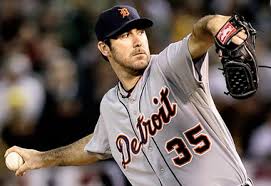

Justin Verlander
In order to get this far, both teams must have good pitching, it is far to difficult win games without above-average pitching. In general, there are three types of outs, ground balls, balls in the air, and strikeouts. Pitchers control strikeouts without the aid of their defense, which makes them quite valuable. Also, the lack of a ball being put in play leaves little room for mistakes, or freak hits like the one that hit Hunter Pence's bat three times before landing in play. The Tigers not only have the best pitcher in the series, Justin Verlander, but they have the two top starters in terms of strikeouts. Max Scherzer and Justin Verlander each had K/9 above 9.00 this season, something no other starter in this series can claim. Consequently these two starters rank 1st and 3rd in fastball usage amongst the other starters in this series, meaning they come at the hitters trying to blow them away, as well as set up their off-speed stuff.  In fact, three of the Tigers four starters have the lowest contact percentages of the pitchers in the series, while all 4 Giants pitchers get contact on 80% of pitches they throw. All 4 Giants starters had 90 or higher FIP- this season while all four Tigers hurlers had sub 90 FIP-.

Tigers pitchers don't allow many base runners, but when they do, only Justin Verlander is able to pitch well with runners on. Fister, Sanchez, and Scherzer give up wOBA's of .310 or greater with runners on base while no Giants starter has a wOBA that high with runners on. So, if the Tigers can keep men off base, they should perform well, but when the Giants pitchers run into trouble, they prove up to the task of keeping production down. So, a good strategy might be to allow Miguel Cabrera and Prince Fielder to reach base, but then shut down the rest of the Detroit offense. The same sentiment is true in high leverage situations. The Giants starters, as a group, have a lower wOBA against in more pressure filled situations than do their American League counterparts.

Overall, it seems like these two teams' starters each have their own distinct strengths and weaknesses. The one factor that truly favors the Tigers is that they begin the series with Justin Verlander, and if Jim Leyland decides it is best, he can have Justin start game 1, game 4, and game 7. The Giants counter with Barry Zito in game one, having used Matt Cain to secure the NL pennant in game 7 of the NLCS, and thus would be at a disadvantage. On the other hand, the only team to use a three man rotation in the last 3 World Series was the 2009 Yankees, so the trend is to use a four man group. In the end, this is the playoffs, and it isn't about power pitching as much as it is about smart pitching. The Giants 4 pitchers all deal well with base runners, men in scoring position, and pressure filled situations, three situations that arrise often when two evenly matched squads play. I give a slight advantage to San Francisco's staff.

Offense:

A team's offense has many parts to it. Some teams hit better for power, others have higher on base percentages, some cause opposing pitchers to work harder than usual. A team's offense is often built around the park in which the team plays. The Giants play in spacious AT&T Park, which yielded the fewest home runs in the majors this season, thus their lineup isn't filled with sluggers like Miggy Cabrera and Prince Fielder, but instead with hitters who make more contact like Marco Scutaro, Angel Pagan, and Buster Posey. The Tigers play in a spacious park as well, but they were able to hit 163 home runs this season in comparison to the Giants who managed only 103, good for last in the Majors.

Buster Posey

Giants
Tigers
MLB Avg
wOBA
0.314
0.328
0.315
HR
103
163
wRC+
99
105
96
BABIP
0.315
0.307
0.297
Runs
718
726
WPA
10.75
2.82
Clutch
5.16
-0.15
Contact %
81.40%
80.60%
79.70%
GB/FB
1.48
1.3
1.33
IFH%
7.00%
5.10%
6.50%
K%
17.70%
18.00%
19.80%
LD%
22.10%
21.70%
20.90%
This chart shows where the two offenses stood in during the season. In order to get this far, the Giants offense has used its strengths. They do a great job of making contact, not striking out, hitting line drives, and most importantly, performing well in the clutch. The Tigers offense looks to score most of its runs when Austin Jackson, Quintin Berry, and Omar Infante reach base because the two hitters that follow them produced the most runs of any two hitters in MLB this season. Cabrera and Fielder will provide the best at-bats in the World Series, but those at bats mean much less if the Giants can keep the hitters who precede them in the lineup from reaching base safely. The more games played in the series, the more it favors the Giants offense, due to their much-increased ability to put the ball in play. On the other hand, the Tigers offense is far superior to the Giants in high leverage situations, and with runners on base. So, if the Tigers can get men on base, their offense has a great chance to do some damage. Overall, offensively, the Tigers have the advantage. Even if this series only goes 5 games, it will be difficult to keep Jackson, Berry, and Infante from reaching base, which makes it more difficult to pitch to Cabrera and Fielder. The Giants pitching is very good, but I don't think it can hold the Detroit hitters from scoring runs.

Relief Pitching:

When it comes to bullpens, which are important in playoff series, let's look at the most used relievers because they are the pitchers the managers trust most, and thus will use most often. For the Tigers those pitchers are Phil Coke, Joaquin Benoit, Octavio Dotel, and despite recent performances, Jose Valverde. Bruce Bochy uses Sergio Romo, Jeremy Affeldt, George Kontos, Santiago Casilla, and Javier Lopez most often. Lopez is a situational lefty, so let's leave him out for now.

In the regular season, the advantage would have gone to the Tigers, with Coke, Valverde, and Dotel pitching very well out of the Detroit bullpen. On the other hand, the Giants pen has been outstanding this postseason, a sign of a winning team. Last year, both the Rangers and Cardinals sported great bullpens in the playoffs, but the Cardinals were able to get more out of their hard throwers than the Rangers did out of their ground ball relievers.

In the NLCS, the only two Giants relievers to let up a run were George Kontos and Guillermo Mota, while the only Tigers reliever to allow a run in the ALCS was Jose Valverde. Tigers relievers threw 11.2 innings in the ALCS and struck out 11 batters while the Giants relievers threw 16.2 innings and struck out 18 Cardinal hitters. In the regular season, Giants relievers relied on ground balls much more than strikeouts while the Tigers bullpen went the opposite way, sporting low BABIPs but also low ground ball percentages. Most importantly, when it comes to clutch situations, neither team's bullpen had the advantage in the regular season, both sported relievers with clutch numbers to the left of the number line and some relievers whose clutch numbers were positive.

Using only the eye test, I would say the Giants bullpen looks better heading into this series than does the Tiger's pen, but the statistics show more of a push. The Giants have used their bullpen more often than the Tigers in the playoffs, and often times, pitchers who don't rely on strikeouts gain an advantage from pitching more often. In the end, the slight advantage goes to the Giants, purely because they have more reliable relievers than the Tigers. Jim Leyland has little confidence in Jose Valverde, and may have too much confidence in Phil Coke, while Bruce Bochy seems confident going to his bullpen whenever he needs to.

Defense:

When it comes to defense, these two teams couldn't be further apart. The three main defensive metrics in use are FRAA, UZR, and DRS. FRAA is a metric used for individuals, but Baseball Prospectus uses a version of Defensive Efficiency called PADE, which was developed by Bill James, to calculate a teams defensive efficiency while factoring in park and league effects. Here are the results.

Angel Pagan Diving to Make a Catch

Giants
Tigers
DRS
-7
-32
UZR
8.6
-28.1
PADE
0.84
-2.36
These statistics are generally seen quite obviously on the field. Just from the eye-test everyone who has watched baseball this season can tell you that the Tigers have a horrible defense. On the other hand, the same visual test makes the Giants out to be a bit better than they are. None of the Giants team defensive numbers is that great, but in comparison to Detroit, they are stellar. A 0.84 PADE is considered above average in comparison to Detroit's -2.36, which BP considers to be horrendous, their word not mine. A positive UZR is above average, and while a negative DRS isn't good, the Giants defense is nowhere near as porous as the Tigers'. The advantage is overwhelmingly in favor of San Francisco. 

Other:

Base running, especially in a series where only 4 wins does the job, can be quite important. According to Fangraphs' base running statistic, the Giants had a 5.5 BsR while the Tigers ranked towards the bottom in the Majors with a -10 BsR. The Giants ranked in the top third in the Majors in base running, whereas the Tigers' mark puts them as the 5th worst base running team in MLB. Advantage here goes to the Giants.

Both of these managers are quite good. Both have won World Series, and have created job security for themselves by leading their team to winning seasons. I can't say there is a distinct advantage for either one, so I give this a push.

The Giants are far more tailored towards doing well at home than are the Tigers. The Giants don't hit home runs, and their pitchers don't strike people out. The Tigers rely on the top part of their order to produce most of their runs and need to get strikeouts in order to win. The Giants' style of play favors both parks in this series because both are larger than average. Advantage here goes to the Giants.

Finally, the Giants have home field advantage, which does not create as big a gap in Baseball as it does in other sports, but has been shown to have some affect. This obviously favors San Francisco.

Overall:

In the end, while three out of the four best players in the entire series reside on the American League side, Baseball is a team game, and the Giants have the better team. It will be close, as neither team has a great overall advantage, but the Giants perform better in more difficult situations and don't rely on specific aspects as much as the Tigers do. Have a well balanced team can have extreme value in a 7-game series.

Prediction: Giants in 6