Wednesday, October 24, 2012

It All Comes Down To This

Tonight it begins. The World Series is the big, flashy, and exciting number that ends the musical that is the Major League Baseball season. In the spring, 29 teams set forth to conquer the baseball world, and one set forth to re-conquer it. The 750 players who began the season on the 25-man rosters of each team clawed tooth and nail, legging out doubles on bloop hits to the outfield, running from left-centerfield all the way to right-center to make a diving catch, and blocking every breaking ball in the dirt in order to attain baseball glory. Unfortunately, for all but 50 this season did not turn out the way they had hoped. Injuries, coaching changes, trades, interviews gone wrong, hanging breaking balls, mental errors, and of course randomness caused 28 teams to falter, and only two to prevail.

The Detroit Tigers and San Francisco Giants will begin the 2012 World Series tonight in the chilly city by the bay to duke it out for the right to be crowned 2012 champions. So, there is little left to do but evaluate the two teams, and pick a winner, knowing that the chances of the series playing out like any of us think it will is ludicrous. Let's go step-by-step, and delve into each team, by looking at their starting rotations, offenses, bullpens, and defenses, to see which team should be more hopeful entering the World Series.

Starting Rotations:


Justin Verlander
In order to get this far, both teams must have good pitching, it is far to difficult win games without above-average pitching. In general, there are three types of outs, ground balls, balls in the air, and strikeouts. Pitchers control strikeouts without the aid of their defense, which makes them quite valuable. Also, the lack of a ball being put in play leaves little room for mistakes, or freak hits like the one that hit Hunter Pence's bat three times before landing in play. The Tigers not only have the best pitcher in the series, Justin Verlander, but they have the two top starters in terms of strikeouts. Max Scherzer and Justin Verlander each had K/9 above 9.00 this season, something no other starter in this series can claim. Consequently these two starters rank 1st and 3rd in fastball usage amongst the other starters in this series, meaning they come at the hitters trying to blow them away, as well as set up their off-speed stuff.  In fact, three of the Tigers four starters have the lowest contact percentages of the pitchers in the series, while all 4 Giants pitchers get contact on 80% of pitches they throw. All 4 Giants starters had 90 or higher FIP- this season while all four Tigers hurlers had sub 90 FIP-.

Tigers pitchers don't allow many base runners, but when they do, only Justin Verlander is able to pitch well with runners on. Fister, Sanchez, and Scherzer give up wOBA's of .310 or greater with runners on base while no Giants starter has a wOBA that high with runners on. So, if the Tigers can keep men off base, they should perform well, but when the Giants pitchers run into trouble, they prove up to the task of keeping production down. So, a good strategy might be to allow Miguel Cabrera and Prince Fielder to reach base, but then shut down the rest of the Detroit offense. The same sentiment is true in high leverage situations. The Giants starters, as a group, have a lower wOBA against in more pressure filled situations than do their American League counterparts.

Overall, it seems like these two teams' starters each have their own distinct strengths and weaknesses. The one factor that truly favors the Tigers is that they begin the series with Justin Verlander, and if Jim Leyland decides it is best, he can have Justin start game 1, game 4, and game 7. The Giants counter with Barry Zito in game one, having used Matt Cain to secure the NL pennant in game 7 of the NLCS, and thus would be at a disadvantage. On the other hand, the only team to use a three man rotation in the last 3 World Series was the 2009 Yankees, so the trend is to use a four man group. In the end, this is the playoffs, and it isn't about power pitching as much as it is about smart pitching. The Giants 4 pitchers all deal well with base runners, men in scoring position, and pressure filled situations, three situations that arrise often when two evenly matched squads play. I give a slight advantage to San Francisco's staff.

Offense:

A team's offense has many parts to it. Some teams hit better for power, others have higher on base percentages, some cause opposing pitchers to work harder than usual. A team's offense is often built around the park in which the team plays. The Giants play in spacious AT&T Park, which yielded the fewest home runs in the majors this season, thus their lineup isn't filled with sluggers like Miggy Cabrera and Prince Fielder, but instead with hitters who make more contact like Marco Scutaro, Angel Pagan, and Buster Posey. The Tigers play in a spacious park as well, but they were able to hit 163 home runs this season in comparison to the Giants who managed only 103, good for last in the Majors.

Buster Posey

Giants
Tigers
MLB Avg
wOBA
0.314
0.328
0.315
HR
103
163
wRC+
99
105
96
BABIP
0.315
0.307
0.297
Runs
718
726
WPA
10.75
2.82
Clutch
5.16
-0.15
Contact %
81.40%
80.60%
79.70%
GB/FB
1.48
1.3
1.33
IFH%
7.00%
5.10%
6.50%
K%
17.70%
18.00%
19.80%
LD%
22.10%
21.70%
20.90%
This chart shows where the two offenses stood in during the season. In order to get this far, the Giants offense has used its strengths. They do a great job of making contact, not striking out, hitting line drives, and most importantly, performing well in the clutch. The Tigers offense looks to score most of its runs when Austin Jackson, Quintin Berry, and Omar Infante reach base because the two hitters that follow them produced the most runs of any two hitters in MLB this season. Cabrera and Fielder will provide the best at-bats in the World Series, but those at bats mean much less if the Giants can keep the hitters who precede them in the lineup from reaching base safely. The more games played in the series, the more it favors the Giants offense, due to their much-increased ability to put the ball in play. On the other hand, the Tigers offense is far superior to the Giants in high leverage situations, and with runners on base. So, if the Tigers can get men on base, their offense has a great chance to do some damage. Overall, offensively, the Tigers have the advantage. Even if this series only goes 5 games, it will be difficult to keep Jackson, Berry, and Infante from reaching base, which makes it more difficult to pitch to Cabrera and Fielder. The Giants pitching is very good, but I don't think it can hold the Detroit hitters from scoring runs.

Relief Pitching:

When it comes to bullpens, which are important in playoff series, let's look at the most used relievers because they are the pitchers the managers trust most, and thus will use most often. For the Tigers those pitchers are Phil Coke, Joaquin Benoit, Octavio Dotel, and despite recent performances, Jose Valverde. Bruce Bochy uses Sergio Romo, Jeremy Affeldt, George Kontos, Santiago Casilla, and Javier Lopez most often. Lopez is a situational lefty, so let's leave him out for now.

In the regular season, the advantage would have gone to the Tigers, with Coke, Valverde, and Dotel pitching very well out of the Detroit bullpen. On the other hand, the Giants pen has been outstanding this postseason, a sign of a winning team. Last year, both the Rangers and Cardinals sported great bullpens in the playoffs, but the Cardinals were able to get more out of their hard throwers than the Rangers did out of their ground ball relievers.

In the NLCS, the only two Giants relievers to let up a run were George Kontos and Guillermo Mota, while the only Tigers reliever to allow a run in the ALCS was Jose Valverde. Tigers relievers threw 11.2 innings in the ALCS and struck out 11 batters while the Giants relievers threw 16.2 innings and struck out 18 Cardinal hitters. In the regular season, Giants relievers relied on ground balls much more than strikeouts while the Tigers bullpen went the opposite way, sporting low BABIPs but also low ground ball percentages. Most importantly, when it comes to clutch situations, neither team's bullpen had the advantage in the regular season, both sported relievers with clutch numbers to the left of the number line and some relievers whose clutch numbers were positive.

Using only the eye test, I would say the Giants bullpen looks better heading into this series than does the Tiger's pen, but the statistics show more of a push. The Giants have used their bullpen more often than the Tigers in the playoffs, and often times, pitchers who don't rely on strikeouts gain an advantage from pitching more often. In the end, the slight advantage goes to the Giants, purely because they have more reliable relievers than the Tigers. Jim Leyland has little confidence in Jose Valverde, and may have too much confidence in Phil Coke, while Bruce Bochy seems confident going to his bullpen whenever he needs to.

Defense:

When it comes to defense, these two teams couldn't be further apart. The three main defensive metrics in use are FRAA, UZR, and DRS. FRAA is a metric used for individuals, but Baseball Prospectus uses a version of Defensive Efficiency called PADE, which was developed by Bill James, to calculate a teams defensive efficiency while factoring in park and league effects. Here are the results.

Angel Pagan Diving to Make a Catch

Giants
Tigers
DRS
-7
-32
UZR
8.6
-28.1
PADE
0.84
-2.36
These statistics are generally seen quite obviously on the field. Just from the eye-test everyone who has watched baseball this season can tell you that the Tigers have a horrible defense. On the other hand, the same visual test makes the Giants out to be a bit better than they are. None of the Giants team defensive numbers is that great, but in comparison to Detroit, they are stellar. A 0.84 PADE is considered above average in comparison to Detroit's -2.36, which BP considers to be horrendous, their word not mine. A positive UZR is above average, and while a negative DRS isn't good, the Giants defense is nowhere near as porous as the Tigers'. The advantage is overwhelmingly in favor of San Francisco. 

Other:

Base running, especially in a series where only 4 wins does the job, can be quite important. According to Fangraphs' base running statistic, the Giants had a 5.5 BsR while the Tigers ranked towards the bottom in the Majors with a -10 BsR. The Giants ranked in the top third in the Majors in base running, whereas the Tigers' mark puts them as the 5th worst base running team in MLB. Advantage here goes to the Giants.

Both of these managers are quite good. Both have won World Series, and have created job security for themselves by leading their team to winning seasons. I can't say there is a distinct advantage for either one, so I give this a push.

The Giants are far more tailored towards doing well at home than are the Tigers. The Giants don't hit home runs, and their pitchers don't strike people out. The Tigers rely on the top part of their order to produce most of their runs and need to get strikeouts in order to win. The Giants' style of play favors both parks in this series because both are larger than average. Advantage here goes to the Giants.

Finally, the Giants have home field advantage, which does not create as big a gap in Baseball as it does in other sports, but has been shown to have some affect. This obviously favors San Francisco.

Overall:

In the end, while three out of the four best players in the entire series reside on the American League side, Baseball is a team game, and the Giants have the better team. It will be close, as neither team has a great overall advantage, but the Giants perform better in more difficult situations and don't rely on specific aspects as much as the Tigers do. Have a well balanced team can have extreme value in a 7-game series.

Prediction: Giants in 6

Thursday, October 18, 2012

How to Win in The Playoffs

How do you win a Baseball game? It's the question that all of us who analyze the game attempt to answer. Well, if we are being honest, most analysis attempts to answer a more specific question, "how do you beat the other teams?" To win a Baseball game, you must score more runs than the other team. Since we are in the run scoring business, how do we create a run? Other than a home run, which is the simplest and most efficient way to create a run, the process begins by getting someone on base. Next, another hitter has to put the ball in play in a way that causes the base runner to safely round 1st, 2nd, and 3rd, base before touching home plate.

 In game 3 of the ALCS between the Yankees and the Tigers, the Tigers scored 2 runs. One came in the bottom of the 4th inning on a solo home run by Delmon Young.  In the bottom of the 5th inning of, the Tigers scored their second run, which also became the winning run. The Tigers number 2 hitter in the lineup, Quintin Berry, led off the bottom of the 5th. The general makeup of an MLB lineup has the hitters who get on base well in the first 2 spots of the order, with the better power hitters in the 3 and 4 spots. Berry played in 94 games this season, batting in the 1st or 2nd spot in the batting order 64 times. Berry is young, fast, and a proficient base stealer. He stole 21 bases this season on 21 attempts. In case your brain stopped working, that's a 100% stolen base percentage. Berry began the bottom of the 5th with a sharply hit ground ball to Yankees third baseman Eric Chavez, who bobbled the ball. Chavez could not throw out the speedy Berry, who reached base safely. The official scorer ruled the play an error on Chavez, but due to the difficulty of the play, it could just as easily been ruled a hit. With the Tigers next hitter, Miguel Cabrera, at the plate, Berry used his speed to swipe second base, putting himself in a position to score a run on a hit. On a 2-2 pitch, Cabrera lined a double over the head of Curtis Granderson into right center field scoring Berry without an issue.

So, to summarize, the Tigers scored 2 runs in the game, one by home run (easy), and the second by getting a player on base, moving him along, and then knocking him in. Since the game ended 2-1, and the only run the Yankees managed to score came on a solo home run by Eduardo Nuñez, only 1 of the three total runs scored in the game was manufactured. So, it would seem as though the ability to manufacture a run is quite important when two similarly matched teams find themselves matched up in the playoffs.

So far in the ALCS the Tigers have outscored the Yankees 11-5. All 5 of the Yankees runs were produced via the home run. In game 1 the Yankees scored 4 runs on 2 two-run home runs. The Bronx Bombers scored zero runs in the 2nd game, and managed only a solo homer in game 3. Other than 2 solo home runs by Delmon Young, the Tigers have manufactured all of their runs thus far in the ALCS.  Why are the Tigers able to manufacture runs so much more proficiently than the Yankees? Since there are not enough games to create a reliable enough sample size in the playoffs, let's use information from the regular season to see why we see such a disparity between the teams' run scoring abilities.

In the regular season, the two men who batted in the top of the lineup for the Yankees were Derek Jeter and Ichiro. These two combined for a .351 on base percentage, in comparison to Austin Jackson and Quintin Berry, the two hitters at the top of the Tigers order, who combined for a .354 on base percentage. So, these two teams' table setters get on base at similar clips. This gives the men hitting in the 3-5 spots the about the same number of opportunities to knock them in, and thus score runs. For some perspective, a .350 on base percentage stands somewhere between above average and great. In fact, in comparison to the American League average this season (.320), both the Tigers and Yankees 1 and 2 hitters got on base much more often than the rest of the AL.

We have established that the Tigers and Yankees are able to get on base, thus completing the first step in run creation. What about step 2? The meat of the orders must find ways to drive in the runs on base, otherwise a high on base percentage at the top of the order means very little. Unlike the Tigers, who bat ted Miguel Cabrera and Prince Fielder in the 3 and 4 holes respectively every game this season, the Yankees used three hitters to fill the two spots. Robinson Cano, Mark Teixera, and Alex Rodriguez shared responsibilities of the third and fourth spots in the Yankee order, shifting from one to the other, depending on health and the handedness of the opposing pitcher. Cano, Rodriguez, and Teixera combined for a .485 slugging percentage during 2012. This was .07 percentage points higher than the American League average (.411). On the other hand, Cabrera and Fielder slugged a ridiculous .567 this season, .156 percentage points above the league average. In fact, the Tigers duo out slugged the Yankees trio by .118 slugging percentage points. So, while it is safe to say both of these teams get on base equally as well as the other, the Tigers severely out slug the Yankees when it comes to knocking in runs. While rbis provide us with less of the story than other statistics, it is important to note that Cabrera and Fielder combined for 247 runs batted in while the Yankees threesome combined for 235.

Why have the Tigers been winning games so much more easily in the playoffs than over the course of the regular season? Pitching has to be the first answer. The Tigers have the best pitcher in baseball, Justin Verlander, and their other starters have stepped up to give their offense a chance every night. On the other hand, the Yankees haven't pitched as badly as we might think. In game 3, Phil Hughes, David Phelps, and the rest of New York's bullpen combined to give up only 2 runs and 12 base runners. So, in a game in which both teams pitched well, the Tigers may have had the advantage because their sluggers hit knock in runs more efficiently than the Yankees.

While this analysis works well with just these two teams, let's open it up a bit. If we include the other two remaining playoff teams, the Cardinals and the Giants, the analysis becomes more fascinating. The top of the Cardinals lineup consists of Jon Jay and Carlos Beltran. With Beltran's recent knee injury, it could also include Matt Carpenter, so I included him in the calculations. During the regular season the Cardinals hitters in the top of the lineup combined to get on base at a .353 clip. The Tigers' hitters did so at .354, the Yankees at .351, and the Giants' hitters at .362. All of these OBPs are very similar with a range of only .011.

What about the guys hitting behind them, charged with the job of completing the process of creating a run? For this, I used a statistic called wOBA. It stands for weighted on base average. According to the explanation on www.fangraphs.com,"Weighted On-Base Average combines all the different aspects of hitting into one metric, weighting each of them in proportion to their actual run value." "The Cardinals hitters, Matt Holliday, Yadier Molina, and Allen Craig, combined for a .388 wOBA with runners on base, while the Giants hitters, Pablo Sandoval, Buster Posey, and Hunter Pence, combined for a .369 wOBA. In the AL, the Yankees three middle of the lineup hitters combined for a .358 wOBA and the Tigers dynamic duo combined for a .407 wOBA with runners on base. Now, if we combine the Tigers' 5th hitter, Delmon Young, into this equation we get a wOBA of .369, but I'm excluding Young because unlike the other teams involved, the Tigers' batting order remained frighteningly stagnant, with Fielder playing all 162 games in the clean up spot and Cabrera batting third 161 out of 162 games this year. The other teams all move their hitters around, thus I used the three hitters who hit most often in the 3 and 4 holes in this analysis.

Look at those numbers. The Tigers get on base at about the same clip as the other four teams, but the production they get from the 3 and 4 spots gives them a distinct advantage. They capitalize more often when the top of their order gets on base than the other three teams left in the post season. The second highest wOBA came from St. Louis, which might also shed some light on why the Cardinals are such a consistently solid playoff team. Oftentimes because teams only play a few games per series these numbers do not have a chance to make a difference, but the Cardinals and Tigers seem to be using them to their advantage. All four teams have pitched well, keeping games close, and in close games, it seems like the Cardinals and Tigers have the advantage.

Many thought that signing Prince Fielder would help the Tigers, but that they spent too much money for too many years. This may be true, but Dave Dombrowski knew his team better than anyone else. He must have seen that by adding such a productive hitter, especially with runners in base, to complement Cabrera, that if his team, despite squeaking into the playoffs, would be the most prepared playoff team.

Scoring a run isn't easy. Home runs happen, but more often, a team working together produces the bulk of the runs. Speedy guys get on base, doing their best to get into scoring position, waiting for the boppers behind them to do whatever it takes to get them home. No one knows who will win the NLCS, but the Tigers are prime to win the ALCS as they head into game 4 up 3-0. If the Tigers and Cardinals meet in the World Series, it will not only be a rematch of 2006, it may also be one of the best World Series in we have seen, as these two teams are so evenly matched, both in preventing runs, and more importantly, in producing them.

Saturday, October 6, 2012

Old School vs. New School

The latest raging debate in baseball concerns who should win the American League Most Valuable Player Award. The choices, Miguel Cabrera and Mike Trout. One side claims that Miguel Cabrera must win the award. He won the Triple Crown for heaven's sake. No, I'm not talking about the horse racing Triple Crown, this is a baseball blog after all, and Miguel Cabrera isn't the name of the most recent jockey or thoroughbred coming out of the gates at Pimlico. This is a feat unaccomplished by thousands of Major Leagues over the last 45 years. Home runs, runs batted in, and batting average make up the three categories in which a player must at least tied for the lead in his respective league in order to claim the glorious Triple Crown. On the other side, we have Mike Trout. 20 years young, and already a phenom. Trout put together a Willie Mays, Mickey Mantle-type season. He posted a wRC+ of 175, wOBA of .422, a DRS of 21, and the highest WAR in the Major Leagues at 10.4. Wait, what in God's name are those hokey looking new-age statistics? WAR? Does that mean Trout is the best chance we have at beating ze Germans on the Western Front? I don't trust that garbage.

This is the debate:

For the last 30 or so years, Baseball has been evolving. Yes, we added the designated hitter, interleague play, and supposedly got rid of steroids, but I'm talking about a revolution. Bring out the guillotine and start chopping off heads. No, not a revolt, but a radical transformation. We didn't bring muskets and a declaration of war (I know the irony is killing me too), instead we brought our slide rules, statistical regression textbooks, and maybe a computer or two. Starting with the father, Bill James, and moving on to greats like John Dewan, Earnshaw Cook, and Tom Tango, the way we look at the game of baseball has changed. Change can often sound like a bad thing, especially for a game characterized as the National Pastime. But stories like the The Natural and tales of the great boys of summer, brought Baseball only so far. The key to moving baseball out of its archaic shell was science. Yes, pesky old science, that class in high school you so royally skipped except when you were set to dissect a frog or a guinea pig. Science crept into Baseball, just as it does with most aspects of life that have yet to be analyzed in depth.

This isn't a new concept. Originally, we as humans thought that the world was flat. In fact, some of the most brilliant minds of the ancient generations, not only assumed, but also proved the world flat. Eventually, around the 6th century BCE, with the help of the great Pythagorus, the ancient Greeks agreed that the world was not flat, but spherical. On the other hand, it took the Chinese until the 17th Century to change their minds, and even some during the time of the great explorer Christopher Columbus thought the earth was shaped like a discus.

Next came the idea of heliocentrism, a concept originally developed by the great Polish scientist and Catholic cleric, Nicolaus Copernicus. Copernican theory stated that the sun stood still while the other bodies in the universe, the earth included revolved around it. This idea was almost the complete opposite from religious doctrine. From the Bible, we can make out that the Earth was the center of the universe, but according to the Pole Copernicus, the sun was at the universe's center. Galileo, the great Italian scientist reproved all of Copernicus' theories concerning heliocentrism, and using his influence in the Catholic Church attempted to sway the Pope to allow him to publish this knowledge as fact. The Pope even asked Galileo to give arguments for both sides in his writings, but Galileo would not allow his name to be associated with false information. In the end, Galileo was sentenced to house arrest for the rest of his life. Not a great endorsement for the Church. 

Finally, science budged its way into the classical idea that God created the world in 7 days. Along came a guy named Charles Darwin who proved, scientifically, that humans evolved through natural selection, which had been going on for millions of years. Even to this day, many religious earthly citizens believe that the world was created in 7 days. Some believe a middle ground called creationism, but the concept of evolution is the only theory ever to be proven, similar to how heliocentrism and the earth being round were previously proven. Much like those other theories, great debates had to be waged in order for the general public to accept them as fact. In the case of evolution that debate was the Scopes Monkey Trial. The trial was between the modernists and the fundamentalists, and while the details of the case concerned a specific law called the Butler Act, the main argument to be made on both sides concerned which was the correct theory, Evolution or Biblical scripture. 

Now, let's jump to the Cabrera vs. Trout debate. Much like the debate between Galileo and Pope Urban, and the State of Tennessee vs. John Scopes, the decision of who wins the MVP won't change every baseball fans' mind, but it serves as a necessary part of the process towards progress. In the years since Billy Beane used the concept of on-base percentage to take pennies and turn them into a playoff team, sabermetrics has claimed many Baseball fans, but hasn't changed the minds of most. The mere fact that the "new-school" sabermetric point of view makes a significant appearance in the discussion for the MVP award gives it more validity than ever before. 


I've heard numerous older pundits and sports people talk about how ludicrous it is to consider anyone but Miguel Cabrera for the MVP award because he won the first Triple Crown in 45 years, and his team made the playoffs. When making this argument all of these sports guys, including Mike Wilbon, Tony Kornheiser, Mike Greenberg, and Mike Golic, always mention that they don't believe any new statistics like WAR means very much in comparison to winning the Triple Crown. This may sound like an ornery and entrenched perspective, but by even mentioning statistics like WAR on national television, these respected sports minds give the sabermetric idea more credibility. 

The winner of the old school vs. new school debate does not depend on the winner of the AL MVP award because no matter the outcome, sabermetric believers have already won just by participating in the discussion. Cabrera may win the award, and while he isn't a bad choice, he is not the right one. New statistics are not scary; they just allow us to analyze the inner workings of the greatest game on the planet. A planet, that we know is spherical, revolves around he sun, and that has supported ever-evolving life for millions of years. 

Thursday, October 4, 2012

!Felicidades Omar¡

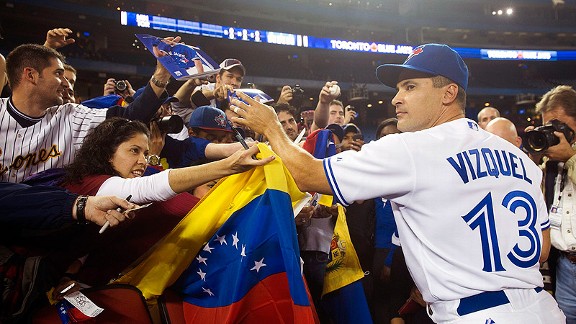
What if I were to tell you that after 24 years at the same job, a true professional has decided to retire. Retirement is a natural part of employment life. 24 years working at the same company, firm, or with the same organization would be considered a lengthy career, one deserving of a send-off party with a cake, party hats, handshakes, hugs, and the obligatory, "speech, speech, speech, speech." Well, what if I were then to tell you that instead of all that, the 24-year veteran employee would get to throw out the first pitch at a Toronto Blue Jays game, in front of 20,000 screaming fans, and three famous fellow countrymen? That sounds like the best retirement party ever.

Yesterday, the final day of the 2012 Major League Baseball regular season, marked the final game for one of baseball's best Venezuelans, infielders, and overall players, Omar Vizquel. For those of you unfamiliar with the 45 year old, here is some history.

Vizquel broke into Major League Baseball with the Seattle Mariners in 1989, the same year as fellow Mariner Ken Griffey Jr. Vizquel came up to the Majors as a shortstop, playing 143 games for Seattle at that position at the age of 21. He stands only 5 feet 9 inches tall, and weighs close to 180 pounds, but he made up for his size with great speed, fantastic hands, and some of the best instincts any modern day shortstop has ever had. Vizquel played 5 seasons with the Mariners, winning a much-deserved gold glove in his final season with the team, before being traded to the Cleveland for Felix Fermin, Reggie Jefferson and cash. He became an instant defensive star for the Indians. As the everyday shortstop for Cleveland for an entire decade from 1994-2004, Vizquel played in 1,478 games, winning 8 gold gloves and attending 3 All-Star games. He was one of the mainstays, the centerpieces, the rocks of the great Indians teams of the mid to late 90's, a team that Cleveland fans still think should have won the 1997 World Series. 

In 2004, at the age of 37, Vizquel could have retired, finishing off a very good career, better than 90% of players drafted or signed by an MLB team. Instead, he signed a 3-year deal with the San Francisco Giants. He ended up playing 4 seasons by the bay, playing in 542 games, averaging 128 hits, 58 runs scored, and 17 stolen bases per season. As a side note, Vizquel averaged 22 stolen bases a season throughout his career, and between the ages of 37-41 he averaged just a tick below that at 17. It doesn't seem like Vizquel ages at the same rate of most MLB players. 

After ending his 4 year campaign with the Giants, Vizquel played one year for the Rangers, 2 for the Chicago White Sox, and his last season north of the border with the Toronto Blue Jays. In those last 4 years of his career, Vizquel played an average of 72 games per season, but in those 72 games he 55 hits a year and a .632 OPS. During his illustrious quartet of seasons, Vizquel played predominantly as utility infielder; filling in at which ever position he was asked to. He played 3rd base, shortstop, 2nd base, 1st base, and even once of twice in left field. For 19 seasons he played almost every game at shortstop, but for the last 4 years, he played wherever he was asked to play. That shows a love for the game.

So, other than a long career, why should we remember Omar Vizquel? There is another, some would say better, player ending a storied career this season, Atlanta Braves third baseman Chipper Jones. Chipper deserves his own article, and once the Braves are booted out of the playoffs, unless they win the World Series, I may very well commemorate Chipper's great career. Today is reserved for Omar Vizquel. According to www.baseball-almanac.com the first Venezuelan national to play in Major League Baseball was Alex Carrasquel who made his MLB debut in 1939 for the Washington Senators. He was a right-handed pitcher whose career lasted for 8 years. Since then, 273 Venezuelans have played Major League Baseball, but there has been only one Omar Vizquel. 


Now that we know who Vizquel is, let's look at some numbers in order to get a sense of what type of player he was. Over the course of his illustrious career, Vizquel compiled a 40.5 rWAR, 47.4 fWAR, and 29.4 WARP. According to Fangraphs, Vizquel has been the 11th best fielding shortstop since 1900, and the 31st best shortstop to play baseball since 1990. The only Venezuelan shortstop to rank higher than Vizquel was the great Luis Aparicio, who ironically showed up in Toronto to watch Vizquel's final MLB game. In the last half century, Vizquel ranks as the 14 best shortstop, higher than the likes of Nomar Garciaparra, Miguel Tejada, Maury Willis, and Edgar Renteria. According to Fangraphs WAR to dollars calculation, over the last decade, Vizquel has been worth $6 million dollars a year on the open market. In 2002 Vizquel turned 35 years old. 

As a hitter, Vizquel never dazzled like some of his contemporaries. He didn't rack up hits like Ripken or Jeter, hit home runs like A-Rod, but he managed to compile 2,877 hits, score 1,445 runs, and 404 bases in his career. He ends his career with more hits than Babe Ruth, Mel Ott, Brooks Robinson, Andre Dawson, and even fellow retiree Chipper Jones. He is also has the third most stolen bases amongst any hitter since 1900 with more than 2,800 career hits. Since 1900, Omar Vizquel has the 6th highest Clutch rating of any Major Leaguer at 7.63, behind only Tony Gwynn, Dave Parker, Pete Rose, Mark McLemore, and Scott Fletcher. Clutch is Fangraphs' way of calculating how well a player performed in high leverage situations. It's calculated as Clutch = (WPA / pLI) – WPA/LI. For more on the stat click HERE. Anything above a 2.0 clutch is considered great, but Vizquel ranks in the top 6 all-time in that category since 1900. Basically, if your team is down by 1 in the 9th inning with 2 outs and runners on 2nd and 3rd, you want the 5'9'' 180 lb Vizquel stepping to the plate because more often than not, he gets the job done. 


By almost every fielding metric in the game today, Vizquel is ranked near the top amongst shortstops. Since 2002, he has 48 defensive runs saved, and topped 20.0 UZR/150 4 times. Since these statistics weren't kept in the 1990's we do not know how good Vizquel was then, but we can only assume his numbers were if not the same, better. One of the most amazing aspects to Vizquel's fielding was his 2007 season with the SF Giants. According to Baseballprospectus' dominant fielding metric FRAA (fielding runs above average), Vizquel was the 8th best fielder in the game that year (13.1 FRAA). DRS(16) and UZR(23.2) concur that Vizquel, at the age of 41, was one of the best fielders in baseball. He defied the well-known idea that as a player ages they break down, with speed and quickness falling off more quickly than hitting ability. In order to be a great defender, especially in the infield, one needs speed and quickness, to say nothing of awareness, acumen, and agility, all of which Vizquel showed after the age of 40. 

So, all of this talk generally leads to the typical, age old, question of, "Is Omar Vizquel a Hall of Famer?" Well, that's a difficult question. he almost reached the immortal number of hits, 3,000. No player to reach 3,000 hits has been denied entrance into Baseball's hallowed up state New York cathedral, but Vizquel fell 123 hits short of that mark. He finished his career with only 59 more strikeouts than walks, but only a career on base percentage of .336. His 11 gold gloves would rank him second among all Hall of Fame shortstops, only 2 behind Ozzie Smith's 13. Shortstops depend somewhat on their double play partners, the second basemen, for good fielding, and Vizquel played with recent Hall of Fame second baseman Roberto Alomar throughout the 90's. On the other hand, Omar was able to win two Gold Gloves without Alomar in the National League in 2005 and 2006. 


Defensively, Vizquel is a no doubt Hall of Famer. Offensively, he lacks a bit. 


Vizquel
Rank Among HOF SS
Hits
2,877
4th
Runs
1,445
5th
Stolen Bases
404
6th
HR
80
11th
RBI
954
11th
Batting Avg
0.272
17th
Gold Gloves
11
2nd

According to Baseball-reference, Vizquel ranks as the 237th best hitter in baseball history, just ahead of Jorge Posada and Hall of Fame shortstop Phil Rizzuto. Will Vizquel be elected into the Hall of Fame? I would ballpark it at a 40% chance he gets voted in. He will be first eligible in 2017, and I don't see him getting in on his first ballot. On the other hand, the decision rests on what the voters value? If they value defense, longevity, and compare him to his fellow shortstops, then I see him becoming part of baseball immortality, but if instead the voters see a hitter with good, but not HOF worthy batting average, on base percentage, and slugging percentage, then he may fall just short. If I had a vote, I would vote for Omar Vizquel. He played the position of shortstop the right way for 24 years. He was a clutch player, who had some of the surest hands, quickest feet, and power arms to play in the hole between second and third base. Most importantly, although not for HOF consideration, he will retire as one of the best Venezuelan Baseball players of all time. In a country where many see Baseball as their means of leaving a country full of narco-barrons and poverty, Vizquel bested the odds and became one of the best players ever. Congratulations Omar, on a fantastic career! Buena suerte en todos sus esfuerzos futuros.