Showing posts with label Pitching. Show all posts

Wednesday, July 11, 2012

Slowing It Down

Pitching, Yes Pitching
The pitcher's mound is 10 inches from the ground, 18 feet in diameter, and 60 feet 6 inches away from home plate.  No game can begin without the man standing 10 inches higher than the rest of the players winding up (that's a fitting phrase), and propelling himself forward towards the other half of the battery squatting behind home plate.  What happens next is too variable to predict, but provides every anticipatory spectator a fleeting moment of excitement.  Poetic rhetoric aside, the pitcher's mound, often dubbed the bump, matters little in comparison to the men who stand atop it.  I've written about pitching and pitchers before, but it fascinates me more than any other topic in sports, thus prepare yourselves for another round of "let's talk pitching".  

All Shapes and Sizes, The Young and the Old
Angels RHP Jered Weaver
One man stands 6 foot and weighs approximately 197 pounds, while the other measures 6 foot 7 inches tall with a slender frame of 205 pounds.  One has 4 Cy Young Awards and the other a Twitter account.  If one were to look at Greg Maddux and Jered Weaver side-by-side, it might be difficult to comprehend that these two men not only both play(ed) professional baseball, but represent two of the best pitchers to do so.  Weaver looks like a typical California kid.  With long dirty blonde hair, a wiry frame, and an odd delivery that looks like he is attempted to fold himself into two, the righty looks like the perfect fit for the Los Angeles Angels of Anaheim. 
In comparison, Greg Maddux, one of baseball's all-time greatest pitchers, does not compare physically to Jered Weaver.  Maddux, a Texan, looks simultaneously bullish and boyish, a combination perfect for a star pitcher in the Major Leagues.   

The Great Greg Maddux
If appearance constitutes only one of the numerous contrasts between Maddux and Weaver, the second is that Maddux retired from Major League Baseball in 2008 while Weaver began his career in 2006.  Third, Maddux and Weaver never played for the same organization, and neither pitcher has ever been linked to one another in any professional manner.  This is where the dissimilarities between the two pitchers stops.  In fact, to underline the similarities, both even have brother's, Jeff Weaver and Mike Maddux, who have previously been or are currently involved in Major League Baseball.  

Nonetheless, why have I chosen, what seems like two random pitchers, to compare and contrast.  While watching a recent performance by Jered Weaver, I noticed a significant difference in his velocity from his first few seasons in the Majors.  Weaver came up in 2006 throwing consistently in the low 90's, often touching 94 mph.  Check out Weaver's career velocity chart, courtesy of Fangraphs.com.
As you can see, Weaver's fastball could never be considered blazing, but the recent trend shows a true dip in his velocity.  In 2011 and thus far in 2012, Weaver rarely heaves his fastball at speeds above 90 mph, let alone the consistent 91-93mph clip he displayed in 2007 and 2008.  What caused Weaver's drop in velocity, and more importantly, how has he remained so dominant despite less zip on his most used pitch?  

The answer is simple, Weaver has adjusted his style and simultaneously matured as a pitcher.  Weaver's change in pitching style reminded me of the other subject of this piece, Greg Maddux.  Maddux, known by most as a control pitcher.  He never utilized high velocities to overpower hitters, but instead used deception, creativity, and pinpoint control to make hitters' lives miserable.  While other legends like Roger Clemens, Steve Carlton, and Randy Johnson went the more conventional rout of getting hitters out with mid to high 90's fastballs, Maddux learned early on that, in order to not become an average pitcher, he had to do something else to compensate for his lack of speed.  It seems as though Jered Weaver may be following in the footsteps of the great Greg Maddux.  

Before we delve further into the velocity discussion, let's compare the two pitchers a bit more.  First, since Weaver has only been pitching for 7 seasons, I only looked at Maddux's first 7 full seasons(1987-1993) as well.  Over his first 7 seasons, Jered Weaver has compiled a 29.4 fWAR, 30.1 rWAR, and 21 WARP (I mention all three types of calculating WAR because each one is a bit different).  From 1987-1993 Greg Maddux spotted a 37.1 fWAR, 30.1 rWAR, and 21.7 WARP.  If we look at WAR/season we see that Maddux, probably due to his outstanding defense, as well as his greater propensity for obtaining ground balls, has an edge.  As a fly-ball pitcher, Weaver benefits from a steller trio of defensive outfielders, Mike Trout, Torii Hunter, and Peter Bourjos.  
fWAR/season
rWAR/season
WARP/season
Maddux
5.30
4.30
3.10
Weaver
4.20
4.30
3.00
For the record, in order to perform these calculations, I doubled Weaver's current WAR numbers from 2012 (the league is at the midpoint of the season and I'm assuming Weaver will remain consistent).  Here are some other numbers to consider: 
HR/9
BB/9
K/9
K's
Maddux
0.50
2.70
6.00
1123
Weaver
0.90
2.00
6.80
1114
Maddux's ability to keep the ball on the ground keeps his HR/9 numbers low.  Weaver does not use the ground ball as well, but keeps batters from reaching base by compiling more strikeouts and fewer walks per 9 innings.  In addition, Maddux' average batting average against vs. left-handed batters from 87' to 93' was .264, while Weaver has put up a .238 average vs. left-handed hitters.  Weaver and Maddux produce outs in different ways because their style of pitching is different, but both yield ace-like results.

When first examining the data, I began to hypothesize that Jered Weaver, pending health status, could end up with a similar career to Maddux.  Now, after some serious thought my prediction has changed.  I now see Weaver as a pitcher who will most-likely come close but not match the iconic level attained by Maddux. Nonethless, both pitchers figured something out about velocity that few other pitcher have done.  Often times, it is control, pitch selection, and dedication to one's craft that exceed the value of a 95 MPH fastball.  
Circle Change Up Grip
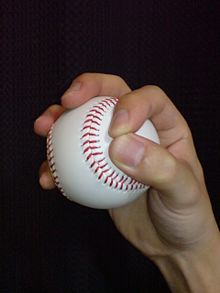
When Greg Maddux began his career in the Major Leagues, his fastball was consistently clocked between 90-92 MPH, but over the next 7 seasons his fastball would more readily be clocked between 88-90 mph.  While the speed of his fastball changed, so did his use of two other pitches.  First, Maddux mastered the circle changeup.  The ball is held against the palm of the hand, thus creating a drop in speed.  Due to the circular grip applied with the thumb and pointer finger, the pitch tends to move inside to righty's and away from lefty's (if the changeup is thrown by a lefty pitcher the movements are the exact opposite).  The most important part of a change up is to have similar arm speed to a fastball, in order to use the difference in velocity to trick the hitter.  Check out this pitch f/x data from an April 7th, 2008 start by Maddux.


The fastballs and change ups all show similar vertical and horizontal movement.  By keeping the movement similar, Maddux continued to fool hitters with a change up despite the fact that neither pitch topped 85 MPH.  It is worth noting that as Maddux's career progressed he threw the straighter four-seam fastball far less, in favor of fastballs that had increase vertical and horizontal movement.

Weaver, like Maddux, may not throw more than 90 MPH, but he has found other ways to keep runners off base.  Weaver's average curveball velocity in 2012 has been 71.5 MPH, slower than many Major League curves.  He throws the hook with incredible 12-6 action creating a huge looping motion that a hitter has extreme difficulty timing.  In addition, Weaver has increased, yes I said increased, the velocity of his slider.  The slider, unlike the curveball, has greater velocity and a harsher break.  With the increase in speed, Weaver keeps hitters even more off balanced than before.  Finally, to complete the pitching comparison between Maddux and Weaver, both pitchers developed a sneaky pitch called a tailing fastball.

Tailing Fastball Grip
Often called a come-back fastball, the tailing fastball, when thrown by a right-handed pitcher, moves from left to right.  Greg Maddux made this pitch famous.  In fact his most famous influence on pitching may be concentrated in this area.  Maddux used the tailing fastball to freeze left-handed hitters who usually feast on fastballs thrown in the mid to high 80's.  He did so by starting the pitch as a ball on the inside and having it move laterally to catch the inside corner as the ball crossed the plate.  Currently, numerous right-handed pitchers, who do not throw overpowering fastballs, utilize the tailing fastball to jam or often strike out left-handed hitters.  According to pitch f/x, Weaver did not throw a tailing fastball for the first 4 seasons of his career.  In 2010 he began throwing the pitch 17.4 percent of the time, which became 19.1% in 2011, and finally in 2012 Weaver's tailing fastball made up 29.0% of his pitches.  

In conclusion, Jered Weaver is not a clone of Greg Maddux, in appearance or as a pitcher.  On the other hand, the two have some parallels, especially similar pitching styles that have made them great pitchers.  According to Baseball-reference.com, Greg Maddux ranks as the 5th best pitcher in baseball history. These rankings are based on fan voting, but at the very least, they give you a decent perspective as to where Maddux might truly rank.  On the same list, Jered Weaver comes in at #284.  I will reiterate that while I do not think Jered Weaver will become the next Greg Maddux, but he has used similar philosophies of pitching, specific tweaks, to enhance his craft and keep him in the annual discussion of Cy Young candidates.  

Wednesday, June 15, 2011

The Injury Bug

In sports vernacular, the "disabled list" (“DL”) or "injured reserve" are commonly used terms thrown around as if the average inhabitant of the earth understands its meaning without the need for further explanation. For those unfamiliar with these terms, they describe a special status given to athletes with injuries in order to allow substitute players to temporarily replace them for the duration of their injury. If I sprain my ankle running, I still come into work or go to class, but professional athletes do not have that luxury. Recently Derek Jeter, who is in pursuit of 3,000 hits, attempted to leg out a slowly hit ground ball and strained his calf muscle. From the moment Jeter left Monday's game due to injury, the media has offered conjecture as to the severity of his injury. Will he will be placed on the disabled list? And, of course, how this will affect his quest to accomplish a goal that only 27 other Major League Baseball player have reached in the sports 230+ years of existence?

Jeter's injury probably won't adversely affect his team's play or their chances to be competitive, especially if his stint on the DL is short. Unfortunately, for many teams, most of the time that is not the case. Many times, an injury, depending on the type, length of recovery time, and who is injured, can dramatically affect a team and its chances of winning. The Minnesota Twins finished first in the AL central last season making the playoffs for the second consecutive season. This season they find themselves in last place mostly due to injuries. The 2011 Twins roster looks fairly similar to the 2010 roster, which begs the question, "Why have they been so bad this season after such a successful 2010 campaign?" The Twins' star players are without a doubt Joe Mauer, Justin Mourneau, and Delmon Young. Mauer has played in only 11 out of 65 games this season, Mourneau has missed 10 games, and Young has missed 20. Three key players on the DL has been the leading contributor to the Twins' struggles. Injuries, especially when afflicted upon smaller market teams with one or two key players, can plummet a first place team to the cellar.

Bigger market teams may avoid this plight. For An example bigger market teams affected but not debilitated by injuries are the Philadelphia Phillies and San Francisco Giants. Recently, the Phillies, for the first time all season, put out their original starting lineup. Chase Utley, Shane Victorino, Roy Oswalt, Joe Blanton, Carlos Ruiz, Dominic Brown, and at least three bullpen pitchers have all visited the disabled list this season. Only recently have the Phillies had a starting 9 with no bench players. Because the team did not lose key players like Roy Halladay, Cliff Lee, Cole Hamels, Ryan Howard, and Placido Polanco to injury, the team has sustained its winning ways. But only a team with talent like the Phillies, Yankees, or Red Sox can sustain a high winning percentage while suffering numerous injuries to crucial players.


The San Francisco Giants lost star catcher Buster Posey for the rest of the season, second baseman Freddie Sanchez for an indeterminate amount of time, and will only now get third baseman Pablo Sandoval back in the lineup after a long DL stint. The Giants, like the Phillies, haven't lost all of their key assets and thus remain afloat and competitive despite injuries to 3/5 of their starting infield. Pitchers Tim Lincecum, Matt Cain, Jonathan Sanchez, Brian Wilson, and Sergio Romo have all remained healthy, thus allowing the Giants to retain their lead in the NL west. Not all teams are so lucky. The Twins are only one example of a smaller market team where 2-3 injured stars have lead to a drop in the standings. The A's and Angels have suffered similar fates. The 2011 Oakland A's were destined to win because of their young but formidable pitching staff. Regrettably, key pitchers Andrew Bailey, Brett Anderson, Dallas Braden, and Josh Outman have all succumbed to the DL for short periods of time. Anderson recently received good news regarding his elbow pain. At first Anderson's meeting with "Tommy John" expert Dr. James Andrews raised alarm bells, but ultimately his injury only required 6 weeks of rehab instead of major surgery followed by 18 months of rehab.

Not all teams are blessed with a prognosis like the A's pitcher Anderson. Last season, Stephen Strasburg burst onto the scene throwing 100 mph and winning baseball games, something few Washington Nationals pitchers have been able to accomplish. He left a game a few months after his debut with tightness in his elbow and received a diagnoses requiring Tommy John surgery. He remains injured, and most likely will not pitch again in the majors until August. In his case, the Nationals not only lose his stellar pitching, but they also miss the thousands more fans that would have attend games in D.C to see Strasburg.

Injuries are not always an awful scenario for a team. Sometimes injuries allow teams to call up highly touted prospects who otherwise wouldn't be called up. Other times injuries cause a general manager to make a trade that leads to better results than expected. Although these situations occur, injuries, especially to starters, always have negative aspects to them. In Derek Jeter's case, his team may barley miss his play, but his pursuit of 3,000 hits will be put on hold. Jimmy Rollins, the Phillies shortstop, suffered a similar injury to Jeter's current calf strain, and when asked about it, said,
"The best advice I can give Derek is, you’re going to get healed in the offseason."
He also mentioned that despite returning to play last season, his calf injury never fully healed until December."When you think your good, you’re not even close," remarked Rollins.
Essentially Rollins is telling Jeter, "Just because you’re about to become the first Yankee to reach 3,000 hits, the 27th major leaguer of all time to accomplish the feat, and secure your eventual induction into the Baseball hall of Fame, don't rush coming back because that may just worsen the injury." This seems to be good advice from someone who plays the same position with similar energy and competitiveness, and suffered a similar injury.

Jimmy Rollins is right. Players should make sure they are healthy before returning to the lineup, no matter how much their team needs them to play because other factors are stake. At the same time, baseball players are commonly referred to as wimpy athletes because they go to the disabled list with injuries like a mild calf strains, blisters, and elbow tightness. In hockey and football players regularly play with injuries more serious than those just mentioned, and such behavior is seen as gallant by fans who see such players as putting their team and teammates ahead of their own personal health. However, such behavior is foolish, especially for injuries like concussions, which can be sustained at any time and have few physical symptoms. I do not have a problem with a player playing injured as long as it is determined that the injury will not affect their play and will not have lasting affects on their health. But when players play through serious injuries, they need to rethink their decision. These injuries may not just affect the rest of their sports career—they may affect them for the rest of their lives.

I seriously injured my elbow pitching in high school. The injury was bad enough that my Orthopedist told me that I needed Tommy John surgery if I was to return to the mound. Instead of going through the surgery and extensive rehab, however, I opted out of the surgery and never pitched ever again. Although I still think about whether I made the right choice, overall I know that not pitching again is probably the best and healthiest choice. Although these decisions are never easy, especially when they affect one's livelihood (in professional sports), players need to consider all of their options and do what is best for their health, which sometimes means sitting out for long periods of time. So, I say to Derek Jeter, 3,000 hits will happen, and despite the media hoopla it does not matter when. So sit out, rehab and return healthy, strong, and ready to join the 3,000 hit club.

Monday, June 13, 2011

Power Rankings June 13th

Top Ten Teams as of June 13th: On Mondays, most sports websites come out with their power rankings. Power rankings are a complete ranking of teams in a sports league from top to bottom. Usually websites list the team, their record and then a small piece about how they have been playing lately. Power rankings often are superficial, worth only a quick glace because they provide little information and are fairly subjective. I find baseball power rankings uninteresting because they rarely surprise me, and untrustworthy due to lack of substance. That being said, for sports for which I have less in-depth knowledge, I like power rankings. They provide me with a quick overall summary rather than requiring me tolook into in depth stats and other analysis to get a sense of what is going on.

Despite my lack of enthusiasm for baseball power rankings, I figured I would provide my own rankings for this week. I won't go into all 30 MLB teams, but I will mention my top 10.

1. Boston Red Sox:
The Red Sox have been on fire the last few weeks. Adrian Gonzalez is proving to be exactly what the Red Sox were hoping he would be: an RBI machine that can hit for average while playing well above average defense at first base. Their pitching has been great too, with old timer Tim Wakefield filling in very nicely for the injured Daisuke Matsuzaka. The Sox pitching staff gave up only 6 runs to a fairly potent Blue Jays offense in a three game series. To give some perspective on the Sox offensive awesomeness, they scored 16 runs in one game against the Jays, which is 2.5 times the number of runs the Jays scored in the whole series. If they keep this up, they will have a chance to sport the MVP (Gonzalez), Cy Young winner (Lester) and at least an AL Pennant.

2. Philadelphia Phillies:
The Phillies are a team with a specific modus operandi. They out-pitch you at least 3 out of every 5 games, most likely 4/5. Halladay, Lee, Oswalt, and Hamels all looked great their last times out, including Oswalt's best start since coming off of the DL. The bullpen has had some ups and downs with injuries and bad pitching from J.C. Romero, but overall most games they only pitch the 8 and 9 innings. Between Madson, Contreras, Stutes (rookie), and Bastardo there isn't much left to want out of the backend of a bullpen. The offense still leaves something to be desired, but with pitching like the Phillies have, you don't need massive amounts of runs. Ryan Howard's batting average is low, but his rbi totals are 3rd in the National League. Chase Utley seems to be hitting his stride lately, but that was against meager Chicago Cubs pitching. Overall the team has a .320 obp which is good for 18th in the majors. If they get number up, more runs will come.

3. New York Yankees:
I thought about putting the Milwaukee Brewers in this spot, but the Yankees can't be overlooked so noticeably, even for someone who despises them. Curtis Granderson, Mark Teixeira, and Alex Rodriguez are doing the heavy lifting for the Yankees offense. Home runs are their go-to weapon, especially for left-handed hitter with Granderson (20), Teixeira (19) and A-rod (13). They use that short porch in right-field to perfection. Pitching-wise, they will most likely lose Jaba for a while, which hurts because he was pitching very well. Colon will go to the DL as well, but they can combat that with good hitting. The Yankees’ strategy for the near future has to be to score lots of runs to back a barely above average pitching staff. Oh, and Jeter accomplishing 3,000 hits is nice too. There is a good article by Tyler Kepner in NYT Sunday sports section on Jeter and Roberto Clemente.

4. Milwaukee Brewers:
Fourth place is where I will put the recently rising Brewers. Greinke, Gallardo, and Marcum make up a solid pitching staff that is currently healthy and pitching well. With Axford handling the end of games, the Brewers have innings 1-6 and 9 covered for probably 4 out of every 5 games. Everything else is dependent upon their hitting which is outstanding. They have: Prince Fielder, 2nd in NL in HR(19), 1st in NL in RBI (58), 4th in NL in BB (37), 2nd in NL in SLG (.627), and 3rd in NL in OPS (1.042) and Ryan Bruan, 6th in NL in HR (14)4th in NL in RBI (48), 1st in NL in R (48), 5th in NL in BB (35), SB (14), SLG (.560), and OPS (.958). The Brewers are designed to win now, and although St. Louis has held the top spot in the NL Central most of the year, the Brewers could easily take over the top spot and hold it until September.

5. Atlanta Braves:
The Braves have come on very strong of late. They have been doing so with all around good play. Their pitching, which is stellar, has been just that, with Jair Jurjens, Tommy Hanson, and Derek Lowe pitching well in their last three starts. Tim Hudson has had his ups and downs this year, but he's a sinker ball pitcher who throws strikes and overall such pitchers do well. Hitting-wise, they have been getting great performances from Brian McCann and Freddie Freeman. Freeman, a rookie, is hitting well against both LHP and RHP. With Jason Heyward on the DL, this team has hung around offensively, and has done so well enough to boast a .576 winning percentage. Much kudos to Frank Wren, GM of the Braves, for putting together a great bullpen of pitchers who all throw hard.

6. St. Louis Cardinals:
Although the Cardinals were recently swept by division rival Milwaukee, the team still has 38 wins, and is only out of the division lead by .5 games. With Albert Pujols beginning to put up better power numbers and Lance Berkman crushing the ball behind him, the Cardinals have the middle of the order muscle needed to win. They also have an underrated pitching staff. Chris Carpenter hasn't pitched up to his usual ways, but Jaime Garcia, Kyle Lohse, and Jack Westbrook are performing at least average to above average. The Cardinals are a good team, but if they don't play very well over the next two months, the Brewers will take a commanding lead in the central that may prove insurmountable.

7. Texas Rangers:
No matter what changes the Rangers make, their success has always been centered around their hitting, and this season is no different. Michael Young, a healthy Josh Hamilton and Nelson Cruz, Adrian Beltre, and Mitch Moreland have given opposing pitchers fits. Young, Kinsler, and Moreland all have OBPs in the top 40 in the AL. Pitching-wise, Jose Ogando has been a great surprise and C.J. Wilson continues to grow and succeed against good lineups. Agreat stat for them is Ogando’s 0.90 WHIP, which is pretty good. They should be able to hold off the Angels and Mariners' meager attempts to win first place in the west.

8. San Francisco Giants:
The Giants are the most puzzling team in the major leagues. Their lineup is riddled with no-names and old has-beens, yet they lead the NL west and have the most come-from-behind wins in the majors. This team uses their huge and oddly shaped ballpark to its advantage. They have a great fan base, a great manager in Bruce Bochy, and probably the best end –of-the-game pitchers in the game. Sergio Romo, Javier Lopez, and Brian Wilson are shut down 8th and 9th inning pitchers who rarely relinquish a lead and predominantly keep their team in the game late, allowing for comebacks. Lincecum hasn't pitched as well as past years, but he has the ability to pitch a complete game shutout every time he takes the hill. With Matt Cain and Jonathan Sanchez behind him, this team will always be in the game. Losing Buster Posey and Freddie Sanchez won't be easy, but this team has yet to stop surprising me this year with their tenacity and ability to prevent opposing teams from scoring, two variables that often lead to victories.

9. Detroit Tigers:
The Tigers have been really good lately. There is no other way to say it. They have given up the six fewest hits of any pitching staff in the AL, which is an improvement from last year. When the Tigers went to the World Series they did it with pitching. Justin Verlander is a top 10 pitcher with top 5 talent. The fact is, although their pitching is decent, their offense is fantastic, carrying them to the top of the AL Central. Miguel Cabrera is putting up MVP-like stats again, though he is getting help from Victor Martinez, Brennan Boesch, and Johnny Peralta. The biggest surprise has been Max Scherzer, who has 8 victories, and a 2.53 strike out to walk ratio. He needs to limit the number of base runners because he pitches better from the windup, but overall he's having a career year.

10. Arizona Diamondbacks:
This may seem odd—the D-back making the top ten—but winning-percentage-wise, they have the Cleveland Indians bested. The Indians were my next choice for this spot, but they have sputtered lately losing 9 out of their last 10. Arizona has the best run differential in the NL west, with a +22 in comparison to the 1st place Giants who have a -3 run differential. The D-backs weren't supposed to be this good, in fact they were supposed to compete with San Diego for the bottom of the NL west, which is code for competing for the worst record in the NL. Their offense is centered around hitting the long ball, they have the 3rd most runs scored in the NL, and they have the top slugging percentage and HR's hit. With a sub 4.00 team ERA that is equal to the major league average, the D-backs have discovered what I call the "Colorado Rockies playbook for success". They take good arms that are unproven and hope they pitch at least at average while allowing their young, speedy, powerful hitters to unleash their impressive power numbers on other average pitching staffs. In the past it has been Carlos Gonzalez, Troy Tulowitzki, Seth Smith, and Todd Helton performing these tasks for the Rockies. In this case Justin Upton, Chris Young, Ryan Roberts, and Kelly Johnson are putting up the necessary power to propel the D-backs into the power rankings top ten.