While many Americans will enjoy their mandatory occupational relief on on December 25th, the hot stove of the Major League Baseball offseason continues to burn, not unlike the ever burning
yule log. With a number of the big name free agents no longer claiming unemployment, many of the contracts being currently negotiated, are the glue guys, not the big bricks. Every team needs players who fill the cracks, solidifying a team's roster, at least on paper. While these players don't command the same amount of media frenzy as say Josh Hamilton or Zack Greinke, oftentimes this lesser signings prove fruitful for teams once summer comes a callin'.
Rays Sign Roberto Hernandez (formerly Fausto Carmona) to a 1-year $3.25 million contract:
This is largest free agent contract ever tendered to a pitcher by the Rays. You might be saying to yourself, "Three and a quarter million dollars is the largest free agent contract given out to a pitcher by Tampa Bay, that figure has to be close to what Josh Hamilton will pay in taxes next year." Such a sentiment wouldn't be out of line, except that the Rays have found that the formula for success in a small market is to grow talent in expensive areas like pitching, and spend the little capital they have on positions players. The Rays' robust success since 2007 shows that their formula works. Moreover, the fact that the Pirates, Mariners, Twins, and Athletics have all employed a similar strategy seals the deal on the Rays' strategy. So, why would the Rays spend the most money they ever have on a pitcher on Roberto Hernandez, a righty sinker-baller who most recently took a year sabbatical due to immigration issues. Hernandez, formerly known as Fausto Carmona, is a tall righty who throws a hard sinker that has led to a career 58.5
ground ball percentage. The Rays recently traded a pitcher with similar numbers to Hernandez, Burke Badenhop. Badenhop sports a career 55.3 GB%, doing so mostly out of a bullpen roll, as opposed to Hernandez who has pitched almost exclusively from the starting rotation. Even after trading James Shields the Rays remain well stocked in the starting pitching department, thus, I expect Hernandez to replace Badenhop in the bullpen. His splits show an ability to force ground balls against both righties and lefties, and with his drop in free passes given out, Carmona has brought his WHIP to a reasonable level for a pitcher who plays to contact (1.36 avg WHIP 2010+2011). He should be an upgrade for the Rays, but it surprises me they would hand out so much money for a bullpen pitcher, which leads me to believe that he may be a quasi-relief pitcher throwing multiple innings per outing.
My Grade: B (Knowing the Rays, they will use Hernandez in such a way to maximize his value, we just don't know how they will play out.)
Cubs sign Carlos Villanueva to a 2-year $10 million contract:
The Cubs are stocking their roster full of starting pitchers that are prime to perform better in 2013 than they did in 2012: Scott Feldman, Scott Baker and now Carlos Villanueva. For a club that doesn't project to be a winning club for another few seasons, these moves make the Cubs out to be akin to a rehab facility. Pitchers with past problems come to the Cubs and leave reinvigorated, rejuvenated, and prime candidates to be moved at the mid-season trade deadline. The Cubs sign these pitchers to contracts that are just high enough to entice them to sign in the Windy City but low enough that teams with a need for starting pitching will be willing to negotiate a trade. Glenn DuPaul of Beyond the Box Score recently published
his thoughts on predictive pitching statistics, pointing towards kwERA as a solid predictor despite it's simplicity. Using DePaul's formula for kwERA, I calculated Villanueva's 2012 kwERA to be 3.65, but his ERA was higher, coming in at 4.16. Given that split, it isn't unreasonable to assume that Villanueva should see some improvement in 2013. Since any team trading for the righty would get him for 1.5 seasons, and would take on only a minimal amount of salary, Villanueva projects as a very tradeable pitcher come July 2013.
My Grade: A- (The Cubs didn't make a large monetary commitment to the Dominican native, and should be able to parlay him for a return of prospects at the trade deadline. In the meantime, Villanueva has job security, a sizeable increase in salary from the $2,770,500 million he made last season, and the possibility to moving to a winning team by the latter part of the summer.)
Brewers sign LHP Tom Gorzelanny to a 2-year $5.7 million contract:
Finally, the Brewers sign a free agent. Up to this point, the biggest move the Brewers front office had pushed through was trading Raul Mondesi Jr. to the Rays in exchange for righty reliever Burke Badenhop. This move also improves the Brewer bullpen, but instead of giving up a very young toolsy prospect, Brewers GM Doug Melvin has committed just under $6 million over two seasons to land Gorzelanny. Gorzelanny hasn't been anything special as far as pitchers go, but since moving to the bullpen, his production has improved. As a reliever, Gorzelanny has posted a 3.76 FIP despite a lower BABIP, which comes from an increase in strikeouts and a decrease in home runs. While Gorzelanny sports better numbers against lefties than righties, the only difference is that he gives up fewer walks to lefties. Is he more confident against lefties? Does he get more calls from umpires? Maybe it's the types of pitches he throws. Either way, in order to justify his salary, Gorzelanny needs to post ~ 0.5 fWins per season. Since moving permanently to the bullpen, Gorzelanny has posted 0.9 fWins in 2 years. Using PECOTA's as a forecasting model, Gorzelanny should play up to his contract. The Brewers haven't addressed their lack of depth in their projected 2013 starting rotation, but have improved their abysmal bullpen, which should buttress their already explosive offense well.
My Grade: B- (Gorzelanny isn't a great bullpen pitcher, but he comes cheap, and even as a league average pitcher, represents an upgrade to the Brewers bullpen. If Gorzelanny can lower his walk rate and induce some more ground balls, he could provide extra value.)
Marlins sign 3B Placido Polanco to a 1-year $2.75 million contract:
This signing defines uninteresting. The Phillies made the easy decision to decline the $5.5 million option on Polanco, allowing him to become a free agent. Polanco spent much of 2012 on the disabled list. When in the lineup, he produced little offensively, but did provide continued above average defense at third base (2 DRS, 4.1 UZR, 5.2 FRAA). Polanco is a contact hitter that rarely strikes out. The key to his success at the plate is to reach base safely, sporting a career .344 on base percentage, but in 2012, Polanco's OBP dropped to a below-average .302. While much of this may have been due to a lower back injury that sidelined him for all but 90 games in 2012, if it is purely a decline in production, Polanco's career may be nearing an abrupt end. If he can put up the .279/.332/.368 slash line that Bill James projects him to produce, than Polanco might be rewarded by a mid-season trade to a contendor, or even another 1-year deal, for more money, in 2014. For the Marlins, this allows the team to either platoon the righty Polanco with lefty prospect Zack Cox, leave Cox in triple A for the year, or some combination of the two. Polanco hails from Miami, so signing there makes a lot of sense for him, in spite of the fact that Miami may compete with the Astros for worst record in MLB in 2013.
My Grade: A (This deal is good for everyone involved.)
Cubs sign RHP Edwin Jackson to a 4-year $52 million contract:
 |
| Edwin Jackson |
2013 will mark Edwin Jackson's 7th full season in Major League Baseball. In 7 seasons, Jackson has played for 6 different teams, having been traded 5 times. Last year he signed a 1-year deal with the Washington Nationals. Jackson has become a "just better than average" starting pitcher. He sports a K%, BB%, and FIP that lie just above the league average. In 2012, Jackson experienced a drop in opponents BABIP (.278), signifying a regression toward the mean (.293) in 2013, but simultaneously saw a spike in his HR/9 (1.09 in 2012 0.72 in 2011). This spike in home runs could be due to pitching half of his games in Washington D.C., which ranks 13th out of 30th in most home runs surrendered by stadium, or it could point to some bad luck. Either way, using Jackson's kwERA and xFIP from 2012 (3.73, 3.79), it would seem that Jackson should put up better numbers in 2013. PECOTA doesn't like Jackson, forecasting him to put up under 1 WARP/season over the course of his new contract. Jackson, like most pitchers, does better after going up 0-1 in an at bat rather than starting the at bat with a ball. Jackson is at the point in his career at which intelligence and adaptability become more important than talent. If E-Jax can learn how to get ahead of hitters more often, combined with the switch to Wrigley Field, he could justify his $13 million AAV (2.6 fWins/season). This contract differs from most that the Cubs have tendered to players of recent in that it is a multi-year deal for a considerable AAV. It signifies that the Cubs are looking a little further down the road, locking up a better-than-average starting pitcher for 4 years. If the price for an "Edwin Jackson" type starter increases in the next 3 years as it most likely will, than by 2015 this deal could look like a steal. In addition, it isn't unreasonable to think that that Cubs will be in contention by 2015-2016, which could make Jackson a valuable and cheapish asset to have under control.
My Grade: B+ (Jackson gets an A for finally getting some job security and the highest AAV he's ever had, while the Cubs get a B. The Cubs are taking a chance, albeit not a huge one, so I can't say this is a slam-dunk.)
Rangers sign C A.J. Pierzynski to a 1-year $7.5 million contract:
After not signing Greinke or Hamilton, and failing to trade for Justin Upton, the Rangers finally make a move. Texas has signed veteran catcher A.J. Pierzynski to a 1-year contract at $7.5 million. Pierzynski put up great numbers in 2012, headed by a major power surge. Pierzynski hit a career high 27 home runs in 2012, leading to a .223 ISO. U.S. Cellular Field in Chicago has long been a hitter park, but it took Pierzynski until 2012 to take advantage of the home-run friendly nature of his home field. According to fielding metrics for catchers, Pierzynski has always been just below average, which is another way of saying playable. Pierzynski had massive splits between lefties and righties in 2012, hitting for a .369 wOBA versus righties last year but only .293 versus lefties last year. He'll be platooning at the catcher position for the Rangers in 2013 with fellow backstop Geovany Soto, making a solid hitting duo at the plate. Pierzynski isn't the long-term solution for the Rangers behind the plate, but since they need to look to upgrade at other positions as well, nailing down the catcher position at a pretty inexpensive price tag works well for Texas. Since the Ballpark in Arlington is as hitter-friendly, if not more hitter-friendly, than U.S. Cellular Field, Pierzynski should expect some attrition in his power numbers, but not by as much as Bill James projects (.223 ISO in 2012, .153 projected 2013 ISO).
My Grade: A- (Pierzynski might have wanted a multi-year deal, but given his age this has to be the best he could do. The Rangers are set at catcher for 2012, and add a veteran presence to their team at a good price.)
 |
| Francisco Liriano |
Pirates sign LHP Francisco Liriano to a 2-year $12.75 million contract:
Remember kwERA? Well, Francisco Liriano put up a 4.01 kwERA and 5.34 ERA in 2012. While neither number points towards great pitching, the 1.33 difference is one of the highest in MLB last year, pointing towards a bounce back year for Liriano. Combine that with his move from Chicago's hitter-friendly U.S. Cellular Field to pitcher-friendly PNC Park, points towards 2013 as a year of improvement for Liriano. Add in some better defense behind Liriano, and he becomes a similar pitcher to Edwin Jackson. Jackson has been more consistent than Liriano, hence the difference in AAV and number of years in this contract in comparison to the one the Cubs gave to E-Jax. This is Liriano's first free agent contract, and at the end of it, he'll still be only 30 years old, allowing him to find another multi-year deal. Pittsburgh needed to upgrade it's starting rotation, becoming the 2nd southpaw of the bunch. PECOTA projects Liriano to put up 1.7 and 1.8 WARP respectively in 2013 and 2014, which would be a significant increase from his 2011/2012 production (0.7/0.0). I also expect Liriano to improve, but the best thing he can do is lower his walk rate. If Liriano can go from a 5.00 BB/9 to a 4.00 BB/9, he might go from being a 1-2 fWin player to a 3-4 fWin player. Given the Pirates recent improvements, and the significant young talent knocking at the MLB door (Gerrit Cole, Jamison Taillon, and Starling Marte), pitchers like Francisco Liriano could help them compete for a Wild Card spot in 2013/2014.
My Grade: A (From what I've seen, the Pirates are positioning themselves perfectly to make a splash in 2013/2014. The Liriano signing is prudent, justified, and a solid pecuniary decision. For Liriano, this is great because it's for more than 1 season, and allows him to pursue more money his next go around on the open market.)
Indians sign Nick Swisher to a 4-year $56 million contract:
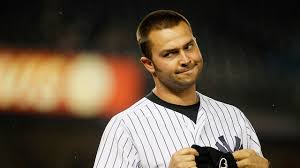 |
| Nick Swisher |
The 2012 offseason market for outfielders was vast, but has diminished in size due to a mix of signings and trades. Overall, those many moves made Nick Swisher a hot commodity. Swisher plays both the corner outfield spots as well as 1st base, provides average defensive ability, almost no speed on the bases, and strikes out at an above-average rate. On the other hand, Swisher is an on-base machine, posting the 14th best on base percentage amongst all MLB outfielders in 2012. He hits for power, posting a .201 ISO, 24 home runs, and collects an extra base hit every 2.5 games. Research has shown that players with good plate discipline tend to age better than those without it. Since Swisher's contract with the Indians will cover his age 32-35 seasons, we can expect Swisher's impressive on-base numbers to hover right around .360. Swisher has had very consistent success from a power-hitting perspective, but given players' tendency to lose some power as they age, we can't expect Swisher to hit 25 home runs per season throughout the course of his newly minted contract. Still, Swisher should remain a valuable player over the next few years, and the forecasting system PECOTA backs me up on this assumption.
|
Projected WARP |
Projected Worth in $(Million) |
| 2013 |
2.2 |
$18.04 |
| 2014 |
2 |
$16.40 |
| 2015 |
1.7 |
$13.94 |
| 2016 |
1.2 |
$9.84 |
Now that we've asserted and, for the most part, confirmed that Swisher is a successful player, let's analyze his new destination. Cleveland made a splash earlier this winter when GM Chris Antonetti traded OF Shin-Soo Choo to the Reds in a 3-team trade, and received Trevor Bauer and Drew Stubbs in return. Stubbs joins Michael Brantley as options to play center field, but the Indians continued to need corner outfielders. With Swisher projecting as the Indians opening day right fielder, it allows Terry Francona to set up a a very good defensive outfield with Brantley, Stubbs, and Swisher playing in left, center, and right field respectively. Here's the problem. Swisher is a veteran who would make a good team into a potential playoff team, but the Indians are a bad team that, even with the addition of Swisher, most likely won't make the playoffs in 2013. Swisher could contribute to playoff pushes for he Indians in 2015 and 2016, but by that point he'll be older and thus less productive. Swisher won a World Series with the Yankees in 2009, but his AAV has broke $10 million for the first time in 2012. This shows he was looking for the team that would give him the highest AAV for the longest term. In addition, Swisher has roots in Ohio as he attended Ohio State University for college before becoming a professional Baseball player. Even though numerous teams were reportedly courting Swisher, Nick took the deal that fit him best.
My Grade: B+ (A+ for Swisher who looks to have gotten everything he wanted out of this deal. The Indians get a C-C+ for the move because while Swisher is an upgrade, the move makes little sense in 2013 because the Indians aren't making the playoffs in 2013 and probably not in 2014 either. It could prove fruitful in 2015 and 2016, but by then Swisher won't be the player he is now. Still, Swisher is an upgrade, plain and simple, both in 2013 and beyond.)

