Wednesday, July 11, 2012

Slowing It Down

Pitching, Yes Pitching
The pitcher's mound is 10 inches from the ground, 18 feet in diameter, and 60 feet 6 inches away from home plate.  No game can begin without the man standing 10 inches higher than the rest of the players winding up (that's a fitting phrase), and propelling himself forward towards the other half of the battery squatting behind home plate.  What happens next is too variable to predict, but provides every anticipatory spectator a fleeting moment of excitement.  Poetic rhetoric aside, the pitcher's mound, often dubbed the bump, matters little in comparison to the men who stand atop it.  I've written about pitching and pitchers before, but it fascinates me more than any other topic in sports, thus prepare yourselves for another round of "let's talk pitching".  

All Shapes and Sizes, The Young and the Old
Angels RHP Jered Weaver
One man stands 6 foot and weighs approximately 197 pounds, while the other measures 6 foot 7 inches tall with a slender frame of 205 pounds.  One has 4 Cy Young Awards and the other a Twitter account.  If one were to look at Greg Maddux and Jered Weaver side-by-side, it might be difficult to comprehend that these two men not only both play(ed) professional baseball, but represent two of the best pitchers to do so.  Weaver looks like a typical California kid.  With long dirty blonde hair, a wiry frame, and an odd delivery that looks like he is attempted to fold himself into two, the righty looks like the perfect fit for the Los Angeles Angels of Anaheim. 
In comparison, Greg Maddux, one of baseball's all-time greatest pitchers, does not compare physically to Jered Weaver.  Maddux, a Texan, looks simultaneously bullish and boyish, a combination perfect for a star pitcher in the Major Leagues.   

The Great Greg Maddux
If appearance constitutes only one of the numerous contrasts between Maddux and Weaver, the second is that Maddux retired from Major League Baseball in 2008 while Weaver began his career in 2006.  Third, Maddux and Weaver never played for the same organization, and neither pitcher has ever been linked to one another in any professional manner.  This is where the dissimilarities between the two pitchers stops.  In fact, to underline the similarities, both even have brother's, Jeff Weaver and Mike Maddux, who have previously been or are currently involved in Major League Baseball.  

Nonetheless, why have I chosen, what seems like two random pitchers, to compare and contrast.  While watching a recent performance by Jered Weaver, I noticed a significant difference in his velocity from his first few seasons in the Majors.  Weaver came up in 2006 throwing consistently in the low 90's, often touching 94 mph.  Check out Weaver's career velocity chart, courtesy of Fangraphs.com.
As you can see, Weaver's fastball could never be considered blazing, but the recent trend shows a true dip in his velocity.  In 2011 and thus far in 2012, Weaver rarely heaves his fastball at speeds above 90 mph, let alone the consistent 91-93mph clip he displayed in 2007 and 2008.  What caused Weaver's drop in velocity, and more importantly, how has he remained so dominant despite less zip on his most used pitch?  

The answer is simple, Weaver has adjusted his style and simultaneously matured as a pitcher.  Weaver's change in pitching style reminded me of the other subject of this piece, Greg Maddux.  Maddux, known by most as a control pitcher.  He never utilized high velocities to overpower hitters, but instead used deception, creativity, and pinpoint control to make hitters' lives miserable.  While other legends like Roger Clemens, Steve Carlton, and Randy Johnson went the more conventional rout of getting hitters out with mid to high 90's fastballs, Maddux learned early on that, in order to not become an average pitcher, he had to do something else to compensate for his lack of speed.  It seems as though Jered Weaver may be following in the footsteps of the great Greg Maddux.  

Before we delve further into the velocity discussion, let's compare the two pitchers a bit more.  First, since Weaver has only been pitching for 7 seasons, I only looked at Maddux's first 7 full seasons(1987-1993) as well.  Over his first 7 seasons, Jered Weaver has compiled a 29.4 fWAR, 30.1 rWAR, and 21 WARP (I mention all three types of calculating WAR because each one is a bit different).  From 1987-1993 Greg Maddux spotted a 37.1 fWAR, 30.1 rWAR, and 21.7 WARP.  If we look at WAR/season we see that Maddux, probably due to his outstanding defense, as well as his greater propensity for obtaining ground balls, has an edge.  As a fly-ball pitcher, Weaver benefits from a steller trio of defensive outfielders, Mike Trout, Torii Hunter, and Peter Bourjos.  
fWAR/season
rWAR/season
WARP/season
Maddux
5.30
4.30
3.10
Weaver
4.20
4.30
3.00
For the record, in order to perform these calculations, I doubled Weaver's current WAR numbers from 2012 (the league is at the midpoint of the season and I'm assuming Weaver will remain consistent).  Here are some other numbers to consider: 
HR/9
BB/9
K/9
K's
Maddux
0.50
2.70
6.00
1123
Weaver
0.90
2.00
6.80
1114
Maddux's ability to keep the ball on the ground keeps his HR/9 numbers low.  Weaver does not use the ground ball as well, but keeps batters from reaching base by compiling more strikeouts and fewer walks per 9 innings.  In addition, Maddux' average batting average against vs. left-handed batters from 87' to 93' was .264, while Weaver has put up a .238 average vs. left-handed hitters.  Weaver and Maddux produce outs in different ways because their style of pitching is different, but both yield ace-like results.

When first examining the data, I began to hypothesize that Jered Weaver, pending health status, could end up with a similar career to Maddux.  Now, after some serious thought my prediction has changed.  I now see Weaver as a pitcher who will most-likely come close but not match the iconic level attained by Maddux. Nonethless, both pitchers figured something out about velocity that few other pitcher have done.  Often times, it is control, pitch selection, and dedication to one's craft that exceed the value of a 95 MPH fastball.  
Circle Change Up Grip
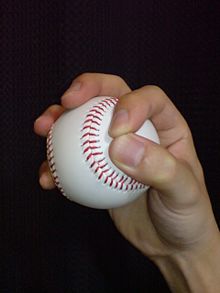
When Greg Maddux began his career in the Major Leagues, his fastball was consistently clocked between 90-92 MPH, but over the next 7 seasons his fastball would more readily be clocked between 88-90 mph.  While the speed of his fastball changed, so did his use of two other pitches.  First, Maddux mastered the circle changeup.  The ball is held against the palm of the hand, thus creating a drop in speed.  Due to the circular grip applied with the thumb and pointer finger, the pitch tends to move inside to righty's and away from lefty's (if the changeup is thrown by a lefty pitcher the movements are the exact opposite).  The most important part of a change up is to have similar arm speed to a fastball, in order to use the difference in velocity to trick the hitter.  Check out this pitch f/x data from an April 7th, 2008 start by Maddux.


The fastballs and change ups all show similar vertical and horizontal movement.  By keeping the movement similar, Maddux continued to fool hitters with a change up despite the fact that neither pitch topped 85 MPH.  It is worth noting that as Maddux's career progressed he threw the straighter four-seam fastball far less, in favor of fastballs that had increase vertical and horizontal movement.

Weaver, like Maddux, may not throw more than 90 MPH, but he has found other ways to keep runners off base.  Weaver's average curveball velocity in 2012 has been 71.5 MPH, slower than many Major League curves.  He throws the hook with incredible 12-6 action creating a huge looping motion that a hitter has extreme difficulty timing.  In addition, Weaver has increased, yes I said increased, the velocity of his slider.  The slider, unlike the curveball, has greater velocity and a harsher break.  With the increase in speed, Weaver keeps hitters even more off balanced than before.  Finally, to complete the pitching comparison between Maddux and Weaver, both pitchers developed a sneaky pitch called a tailing fastball.

Tailing Fastball Grip
Often called a come-back fastball, the tailing fastball, when thrown by a right-handed pitcher, moves from left to right.  Greg Maddux made this pitch famous.  In fact his most famous influence on pitching may be concentrated in this area.  Maddux used the tailing fastball to freeze left-handed hitters who usually feast on fastballs thrown in the mid to high 80's.  He did so by starting the pitch as a ball on the inside and having it move laterally to catch the inside corner as the ball crossed the plate.  Currently, numerous right-handed pitchers, who do not throw overpowering fastballs, utilize the tailing fastball to jam or often strike out left-handed hitters.  According to pitch f/x, Weaver did not throw a tailing fastball for the first 4 seasons of his career.  In 2010 he began throwing the pitch 17.4 percent of the time, which became 19.1% in 2011, and finally in 2012 Weaver's tailing fastball made up 29.0% of his pitches.  

In conclusion, Jered Weaver is not a clone of Greg Maddux, in appearance or as a pitcher.  On the other hand, the two have some parallels, especially similar pitching styles that have made them great pitchers.  According to Baseball-reference.com, Greg Maddux ranks as the 5th best pitcher in baseball history. These rankings are based on fan voting, but at the very least, they give you a decent perspective as to where Maddux might truly rank.  On the same list, Jered Weaver comes in at #284.  I will reiterate that while I do not think Jered Weaver will become the next Greg Maddux, but he has used similar philosophies of pitching, specific tweaks, to enhance his craft and keep him in the annual discussion of Cy Young candidates.  

Thursday, July 5, 2012

What a Relief

The Background

The Book...Enough Said
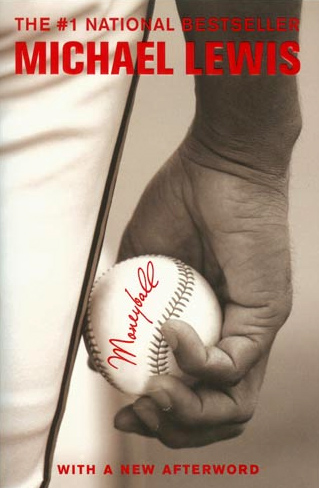
In Michael Lewis' famed book, Moneyball, he hammers home the point that the A's did not stumble upon the idea, that in order to build a winning team with very little money, a General Manager must find market inefficiencies to exploit.  The idea comes from economics.  Market inefficiencies arise when one agent within the market uses their power to block mutual gains from trade, leading to imperfect competition.  Essentially, if one entity within the market abuses their stature by obstructing the natural flow of a certain good, it can cause monopolies to arise.  To quote the book that opened so many people's minds to the statistical revolution that is still occurring in baseball, "The chief social consequence was to hammer into the minds of a generation of extremely ambitious people a new connection between "inefficiency" and "opportunity," and to reinforce an older one, between "brains" and "money."

Moneyball was written in 2003; a movie based on the book was released in 2011, and because of the book almost every major sports news channel on television includes statistics like on base percentage in its usual stat line.  This begs the question, why am I digging up an argument that most sports fans have heard of? The reason I mentioned market inefficiencies and more importantly Moneyball is that Billy Beane, the General Manager of the Oakland Athletics, continues to find market inefficiencies to exploit in order to keep his team relevant amidst a sea of fat cats, copycats, and monopolies (thought I had a third cat phrase didn't you?).

Back to our brief economics lesson, let's talk about externalities.  An externality is a transaction that does not occur through prices, and affects a party that had no say in the transaction that caused the issue.  Externalities can range from global climate change to taking too much time in the checkout line at your local grocery store.  How do externalities and market inefficiencies affect Billy Beane and the Oakland Athletics? Beane's small-market team has little money to throw around in order to, simply put, win.  In order to combat this lackluster position, Beane and his front office team, scourer the baseball landscape for the numerous market inefficiencies that have occurred, most often due to externalities, to exploit in order to bring success and prosperity to the "other" city by the bay.

Beane's most recent revelation concerns relief pitching.  Starting pitchers usually pitch anywhere between 5-9 innings per game.  Starting pitchers who average more an 7 innings pitched per game are usually aces, while pitchers who average fewer than than 6 innings pitched per game rank closer to average/below average in performance.  No statistic is without outliers, and Stephen Strasburg represents a great outlier.  The Nationals purposefully limit his innings pitched despite his stellar ability, in order to protect his arm in the long-term.  Nonetheless, starting pitchers rarely throw complete games, which causes managers to utilize their bullpens often.

Combine the effect of fewer innings pitched by starting pitchers, with the new model of the modern bullpen and you change the market for pitchers.  Tony La Rusa, the soon-to-be Hall of Fame manager of the Oakland A's and St. Louis Cardinals, started the current bullpen paradigm of lefty specialists, set up men, and the worst of the bunch, the rigidly limited closer.  This shift in bullpen dynamics, combined with the invention and overvaluing of the "save" statistic, has led to a market inefficiency.  When specialization occurs, oftentimes the salaries of those filling these specialty roles rise.

Let's examine the most lucrative specialty, the closer.  The average salary for a closer in 2012, excluding closers still signed to a minor league deal, and including injured closers and their replacements, is about $6 million.  These are pitchers who generally pitch for an inning in which their team is ahead by no more than 3 runs.  Sometimes closers are put in in tie games, and when they haven't pitched in a while, the manager may choose them to pitch in order to stay sharp.  Supposedly these "rules" are placed on a closer's usage because the 9th inning involves so much added pressure, that only certain players can successfully get the last three outs of a game.  My argument here is not that closers are useless, (sort of) or that the system in which they are employed is inherently flawed (it is).  The point I'm trying to make is that Billy Beane and his cadre in Oakland discovered that because of system in which closers pitch, the market has overvalued them, and will most likely continue to do so.

Bailey, Street, and Cook

Heading into the 2011-2012 off-season, the Oakland A's were coming off of a losing season, but one on which the team could build.  The Athletics finished the 2011 season with a 74-88 win-loss record, a .457 winning percentage that left them 3rd out of 4 teams in the American League West.  Despite this record, the A's held a number of solid young players that, with some experience and help from veteran talent, might produce winning seasons in 2012 and beyond.

All of this seems reasonable but the Oakland A's are not your average MLB team.  With so little money to utilize, the A's must constantly use a strategy employed by the Tampa Bay Rays as well as the financial sector.  The strategy is called arbitrage.  Arbitrage is the act of taking advantage of price differences between markets by making one or many deals in order to capitalize on the imbalance.  In his book The Extra 2%, Jonah Keri talks about how the Rays utilize the idea of arbitrage when making player based decisions.  Mr. Keri explains it simply as "acquiring an asset for less than it's worth, especially when coupled with selling an asset for more than it's worth."  The Athletics have recently used this approach to exploit the overvaluation of closers and other relief pitching slots in order to improve their team.

At first glance, Huston Street seems more like then name of a road rather than the name of a Major League Baseball player.  Street attended the University of Texas, and was drafted by the Oakland Athletics in the 1st round of the 2004 MLB draft.  Street came out of the bullpen in college and the A's had no desire to change that approach.  He pitched for the A's from 2005-2008 at an average of $1,083,906.25 per season.  He was paid $3.3 million in his final season with the A's, one in which they traded him elsewhere.  Street came out of the bullpen as the Athletics closer.  His stats from his bay area years are depicted below.

Team
ERA
SV
IP
K/9
H/9
Athletics
2.88
94
269
9.07
7.03
HR/9
WHIP
LOB%
WAR
xFIP
BB/9
0.6
1.07
74.30%
6.9
3.51
2.61
After producing these fine numbers for the A's, they traded him, Carlos Gonzalez, and Greg Smith to the Colorado Rockies for Matt Holiday.  Holiday played for the A's and was then traded to the St. Louis Cardinals for prospects Clayton Mortensen, Shane Peterson, and Brett Wallace.  Wallace was then traded to the Blue Jays for outfield prospect Michael Taylor.  Confused yet?  Well if you aren't, let's move on.

Street was first, but Bailey came next.  The Athletics drafted pitcher Andrew Bailey in the 6th round of the 2006 MLB draft.  After spending a few years in the minor leagues, Bailey was brought up to the team to fill the vacant closer's spot left by Huston Street.  He immediately won rookie of the year and was selected to the All-star team, 
thus boosting his profile in Major League Baseball.  In addition, he compiled these statistics:

Team
ERA
SV
IP
K/9
H/9
Athletics
2.07
75
174
9.0
6.05
HR/9
WHIP
LOB%
WAR
xFIP
BB/9
0.57
0.95
81.70%
4.4
3.4
2.53
In 2012 Bailey was once again selected as the Athletics representative to the American League All-Star team.  Seeing that Bailey was a competent closer who, like Street before him, would be overvalued on the free agent and trade markets, Billy Beane traded his young commodity.  In this case he traded him to the Boston Red Sox for outfielder Josh Reddick, prospect Miles Head, and prospect Raul Alcantara.

Now that we have discussed Street and Bailey, let's move on to Ryan Cook.  Who is Ryan Cook?  If you guessed that he is an Oakland Athletics relief pitcher, you would be right.  Cook has recently been placed in the closer's role in the A's bullpen.  His statistics thus far can be seen below.

Team
ERA
SV
IP
K/9
H/9
Athletics
1.50
8
?
9.25
3.0
HR/9
WHIP
LOB%
WAR
xFIP
BB/9
0
0.92
82.90%
0.8
4.39
5.25


Okay, you got me; I may be throwing a whole bunch of statistics your way, but I neglected to tell you the sample size.  Cook has only thrown 36 innings out of the pen thus far this season.  The numbers Cook is putting up could easily normalize and become only average, but I don't think that will happen.  Oh, I think he may give up a home run eventually, but I have faith that by the end of the year, Ryan Cook will look like a solid choice as a closer.  He may be utilized in that role for the A's for the rest of this season as well as next season.  Interestingly, Cook was one piece the A's received when they traded SP Trevor Cahill to the Diamondbacks and the A's currently pay him $480,000 a year.
Ryan Cook

The Athletics play in a great pitcher's park, thus inflating their pitcher's stats and deflating those compiled by their offense.  With recent closer's being signed to deals like 4 years for $50 million (Jonathan Papelbon to the Phillies) and 3 years for $27 million (Heath Bell to the Marlins), many teams may jump on the chance to trade for Ryan Cook and utilize his arbitration years (the first of which is in 2015) or even sign him to a more moderate contract.  The A's may not garner an incredible package of players for Cook, but with the advanced metrics they deploy, the scouts they trust, and the replaceability of Cook, anything the A's get in return may make such a deal true arbitrage.

Finally...

In the end, I am predicting a situation based on lots of facts, a pattern, and some assumptions.  Teams devise new ways to improve themselves everyday, but Billy Beane has definitely found a market inefficiency to exploit in the production and selling of bullpen pitchers.  He uses them for his own team only while he pays them less than $1 million, then sells them for other players to teams who can, and will pay them more money.  The Athletics need all of the help they can get when it comes to winning, and Billy Beane is the man to keep them ahead of the curve.  Whether he uses simple economic principles like market inefficiencies, arbitrage, and positive gains from externalities, Beane continues to succeed.  Maybe, that's why he has been the Athletics General Manager for 15 seasons, the longest current streak in Major League Baseball.  

Monday, July 2, 2012

What Year Is It?


(It is my pleasure to introduce Morris Levin.  In addition to being the first guest writer on www.summerpastime.com, Morris Levin is an alumnus of Mitchell & Ness Nostalgia Co. He lives in Philadelphia, where he roots for the Phillies, win or lose. He is a proud booster of the Athletic Base Ball Club of Philadelphia and supportive of efforts in West Philadelphia to honor the legacy of the Philadelphia Stars.)

“It's beginning to smell a lot like 1979 around here”
Are the 2012 Phillies Mirroring Their 1979 Counterparts?

Expectations were high for the Phillies entering the 1979 season. The Phils had won the division with 101 win in 1976, 101 in 1977, and 90 in 1978. But in each of these seasons, they had lost the National League Championship Series.

The Phils had very strong clubs. Catcher Bob Boone, infielders Larry Bowa, Dave Cash, and Mike Schmidt, outfielder Greg Luzinski, and pitcher Steve Carlton were all repeat All-Stars. But they could not make it to the World Series.

Player free agency in Major League Baseball was a still a relatively new phenomenon in the late 1970s. After losing to the Los Angeles Dodgers in the 1978 National League Championship Series, the Phillies seized on the opportunity presented by all-time great Pete Rose’s first entry into free agency.

Rose had reached his 3,000th career hit in 1978, and hit in 44-straight games. Rose and Reds management were at odds, and the Phillies signed Rose for a then record four-year $3.2 million contract. Rose would be the piece that pushed the Phillies over the hump to the Series.

Prior to the 1979 season, Phils manager Danny Ozark had publicly speculated that his club lacked player leadership. Rose would lead the team to the World Series. The Phillies were very good with him and became stocked with him. Like having four ace pitchers.

Know what happened? The team finished fourth.

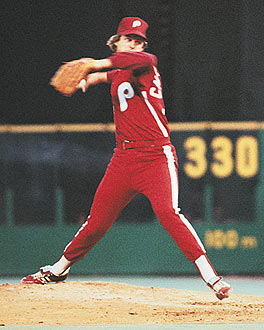
Larry Christenson of the 1979 Phillies
Reliable starting pitcher Larry Christenson cracked his shoulder in the preseason. Carlton started the season wounded. You think the 2012 Phillies are old? The planned 1979 rotation had Carlton at 34 years old, Jim Lonborg at 35 years old, and Jim Kaat at 40 years old. The team wilted in front of the media; Larry Bowa publicly lamented the added pressure and questioned whether the team could meet the expectations.
The 2012 Phillies bullpen is struggling so much that Chad Qualls was released by way of example. Tug McGraw led the 1979 team in saves with 16 and had an ERA of 5.16. The great McGraw was more Brad Lidge circa 2009. Ron Reed pitched 100 innings out of the pen and had an ERA of 4.15.

Rose continued his dominance, hitting .331 in 1979, and Schmidt cracked 45 homeruns with 114 RBIs. But midseason injuries to Luzinski, stellar double play combo Bowa and Trillo sank the team. By July 1st, the Phillies’ record was 39-38; fifth place in the six-team division, and still 7½ games back. By August 29, the team had fallen to fifth place and two games under .500, 12½ games behind the Pirates.

Trillo sustained a broken forearm on May 3 when he was hit by a pitch. Bowa broke his thumb May 22 diving for a ball in a win at home against the Cardinals. Garry Maddox went down injured, and later that summer Greg Luzinski was hurt. By mid-August, fifteen players had been to the disabled list and the Phillies were eight games out of first place. The team's decline led to the firing of manager Danny Ozark on August 31.

Yeah. 1979 was not a fun season for baseball at the sports complex in South Philadelphia under the weight of World Series expectations, and a fan base for whom winning the division, a dream five years ago, expected.

Here we are in July 2012 and the Phillies are mired under .500. Injuries to Ryan Howard and Chase Utley, Roy Halladay, and the middle-relievers have badly hurt the club. This does not exonerate Cliff Lee, Shane Victorino, and other playing at or below career averages. Nor does it exonerate management from not signing surer outfield hitting whether it may have been a Josh Willingham, Jason Kubel, Carlos Beltan, (or even resigning Raul Ibanez for one season).

Jimmy Rollins Hoists The World Series Trophy In 2008
The Phils should be able to right the ship in 2013. Whatever permutation in 2013 of Hamels or Halladay or Lee or Worley is around should be strong. Howard should be back following precedent that players who previously had Howard’s injury come back strong in their second year back and not their first. All the more reason the team should have signed one of the above rather than leaving it at the combination of Nix-Wiggington-Thome-Mayberry.

Money will be available from the contracts of Joe Blanton, Placido Polanco, and Shane Victorino. Howard plays first. Utley or Martinez plays second. Rollins is at short. The Phils will have a new third-baseman and left fielder. And at best they will have Halladay, Lee, and Hamels, and at worst, Lee, Halladay, and Worley.

It was the 1980 Phillies club that won only 91 games, fewer than the 1976 and 1977 teams. But it was this team that won the club’s first World Series in its then 98-year history. The Phillies made mistakes during this past off-season by failing to replace Howard’s production at first, and Ibanez’s in left. But this franchise is not ready to head quietly into history.

After the dreadful 1979 season, the Phillies won the division, National League pennant, and World Series in 1980; won a play-off spot in the strike-shortened 1981 season; and won the pennant in 1983. The Phils may not win in 2012 but 2013 need not be a disaster.

Friday, June 29, 2012

Now What? Part III

"Now What" has been a series of articles concerning the financial woes and successes of professional athletes after retiring from sports.  Let's recap.  Part I focused on athletes who lost it all, spent/invested unwisely, and could have considered burning their money as a better alternative.  Part II went down the other path, exploring the post-athletic careers of Magic Johnson, Mo Vaughn, and others.  These men put their millions to good use, helping communities and turning a profit at the same time.  The third and final installment focuses on the future.  Will former athletes continue to make headline news with their financial blunderings, or will something change?

Professional athletes make incredible amounts of money.  With average salaries going up every year, being drafted gives athletes the opportunity to make more money than many Americans will make in their lives.  Although most people rightly see this as a blessing, it has also become a curse.  Athletes are seen as rich playboys who spend their money on all sorts of frivolous and unconscionable mansions, cars, and other toys.  Few people see the likes of Warren Buffet, Bill Gates, or Michael Bloomberg in a similar light.  Instead these billionaires transcend their own money, seen as smart and prudent instead of vacuous.  So far, I have delved into the many causes of this irresponsible spending and investing on the part of former professional athletes, but I have not given a forecast for the future or a comprehensive way to solve these issues (education being the only solution I previously referenced).  


Athletes, like presidents, should have both a keen mind and good advisors.  To expect every professional athlete to be schooled in post-keynesian economics, or how global trade effects their annual salaries is a futile task.  On the other hand, it would not be unreasonable for every professional athlete to read a chapter of "Freakonomics" or "Personal Finances for Dummies" every week.  Professional athletes, who have just entered the world of the upper class, should have a rudimentary understanding of taxes, investments, and banking.

We all have certain predispositions from our childhoods, whether we were originally dirt poor or wealthy, that cause us to make certain decisions.  Situations arrise, such as the poor black basketball star who wants to buy his mother the house she could never afford, or the Yale graduate who uses his money to set up trusts for the children he hasn't borne and the wife he has yet to marry.  Both scenarios have validity and neither necessarily constitutes a bad decision.  An athlete should be able to buy his mother a mansion, but simultaneously understand that he cannot buy every friend from his neighborhood one as well.  Limits exist, and as the old adage goes, everything in moderation.  These are lessons every athlete should learn.  Not only should these newly minted millionaires have at least a minor knowledge of money, they should hire the right people to oversee their wealth on a day-to-day basis.  Making your best friend your financial advisor probably won't work unless he recently received his MBA from Wharton.  Hire a team of financial advisors to manage your considerable wealth, it's exactly what most upper-middle class and upper-class Americans do.


Luke Skywalker
In Star Wars, Luke Skywalker is depicted as the only remaining hope to save everyone from the evil empire.  George Lucas' first film is titled "A New Hope".  Don't worry, I don't think I've found the one athlete who will save the rest from financial ruin, but I do think Andrew Luck should be the next poster child for "best financial decisions made in a career".  Nothing has been written in stone, much of this is speculation. 


Andrew Luck, son of Oliver and Kathy, brother of Addison, Mary Ellen, and Emily Luck, and the most recent quarterback to be chosen number one overall in the NFL draft, possesses immense talent, intelligence, and upside.  When the Indianapolis Colts selected Luck no.1 overall in the 2012 NFL draft, they knew what they were getting.  They wanted the next Peyton Manning, and from most accounts and predictions, Luck may be a Manning look alike.  He stands 6 foot 4 inches tall, weighs about 230 pounds, throws a football at the speed of an intercontinental ballistic missile with the accuracy of a skilled marksman.  His athletic abilities are only matched by his gifted mind.  Luck was co-valedictorian of his high school class, entertained scholarships to Northwestern, Rice, and the University of Virginia, and chose to attend Stanford University.  


Andrew Luck
By all accounts, the 22-year old is athletic, smart, and a soon to be inductee into the select group of professional athlete millionaires.  Will Luck be smart with his money?  He comes from solid stock.  Luck's father, Oliver, played quarterback in the NFL for the Houston Oilers.  After retiring, the senior Luck received his law degree from the University of Texas, and moved to Germany to practice law.  Following an unsuccessful run at a seat in the United States Congress, Oliver Luck was named the CEO of the Houston Sports Authority.  Next, he took a position as the athletics director of his alma mater West Virginia University.  So, it seems young Andrew has a pretty good role model to look to for guidance in both his athletic and post-athletic pursuits.  Luck has a good advisor, but how about his personality?  According to an article in USA Today, Luck rode his bicycle around the Stanford campus instead of toting an expensive car.  He decided to forgo the NFL after his junior year of college to return for his senior year.  Luck graduated with a bachelors degree in architecture, carrying a 3.48 GPA while studying his other major, football.  


So it seems like this young man has the makings of someone who will not only succeed on the field but off of it as well.  He has a good head on his shoulders, strong role models, a great arm, and most importantly a solid attitude.  If ever there was someone whom young athletes should emulate, it is Andrew Luck.  I predict that, no matter the direction his football career takes, Luck will be successful in many spheres, especially financially. 


Well, folks, this trilogy has now come to an end.  I've profiled financial dunces like Curt Schilling and Allen Iverson, movers & shakers like Magic Johnson and Mo Vaughn, and the star of the future, Andrew Luck.  All of these men have one thing in common.  They all played or will play professional sports.  In fact, they have succeeded or most likely will succeed in their given sport.  The X-factor with these men, and all professional athletes, remains the manner in which they treat their status of "wealthy".  Education, solid role models, and above all else a strong attitude constitute the most important factors of financial success, even for those with the most money.   


Wednesday, June 27, 2012

Now What? Part II

Erving "Magic" Johnson co-owner of the LA Dodgers 
In the first installment of the "Now What?" three part series, I explored the problems many professional athletes encounter in their post-sports careers.  Professional athletes usually retire with large sums of money that they must then put to some use.  As was previously discussed, athletes like Curt Schilling and Allen Iverson chose paths that inexorably led them towards bankruptcy and humiliation.  In part II, I will delve into the lives of those professional athletes who have experienced financial success following productive and lucrative careers in sports.

Michael Jordan was the greatest basketball player the world has ever seen.  Few people would truly disagree with that statement.  What is the answer to this question: "Who was the greatest point guard ever?"  Not everyone (Celtics fans), would say Magic Johnson, but I would.  Johnson won 5 NBA championships, 3 league MVP trophies, and 3 Finals MVP trophies, and those are only a few of his accolades.  Magic Johnson, by all accounts, had one of the most prolific NBA careers of all time, but it was cut short when he discovered he was HIV positive.

For many professional athletes at the height of a hall-of-fame career, this news would cause them to become recluse.  Instead, Johnson decided to begin his second career, as a businessman.  Not long after retiring from the NBA in 1995, Johnson began searching for investors for an urban rebuilding project he predicted would become a money maker.  Most rejected his proposal, but friends urged Johnson to use his considerable wealth for the venture.  Johnson's proposal was to put in place food, retail, and entertainment stores into predominantly poor, black, and hispanic neighborhoods in Los Angeles.  He believed he understood what the people in these communities wanted.  Where most saw dilapidated  shopping centers, Johnson saw a business opportunity, one in which he could dually profit and supply desired demands to lower-class citizens of Los Angeles.

He showed his business acuity by meeting with gang leaders, the California Public Employees' Retirement System, and other community leaders in order to perfect his investment plans for urban Los Angeles.  He instituted different food and beverage options in the blacker area movie theaters, switching from the usual options to sweeter drinks, spicier hot dogs, and buffalo wings.  Johnson racked up business success after business success, eventually leading him to create Magic Johnson Enterprises, a company Forbes estimates to be worth over $700 million.  He owns 5% of the Los Angeles Lakers and recently joined Guggenheim Partners and Stan Kasten in buying the Los Angeles Dodgers.  Success after a professional sports career doesn't even begin to describe Magic Johnson, he is a  tycoon.  


Mo Vaughn, MVP turned Businessman
If Magic Johnson represents one end of the spectrum and Allen Iverson the other, Mo Vaughn sits comfortably between them.  Maurice "Mo" Vaughn played professional baseball for 13 seasons, accumulating just over $100 million in the process.  He made 3 All-Star teams and was crowned the 1995 American League Most Valuable Player.  Two events, one negative and the other positive, happened in Vaughn's post-MLB career.  First, the Mitchell Report demonstrated that he knowingly took performance enhancing drugs supplied by Kurt Radomski.  Second, he decided to invest in creating better living spaces for poorer New York City residents.  


Towards the end of his MLB career, the Anaheim Angels traded Mo Vaughn and his $70+ million contract to the New York Mets.  Once in New York, Vaughn experienced debilitating injuries that forced him to retire in 2003.  After retirement, Vaughn, the child of a high school teacher and principal, decided to give back to the city he felt he had failed.  Instead of donating money to non-profit charities, Vaughn decided to assist New York City and simultaneously begin his second career.  The former Red Sox 1st baseman created OMNI New York LLC., a company whose main goal is to invest in and repair low-income-housing.  Vaughn partnered with savvy businessmen and others more experienced in the world of low-income housing in order to create a juggernaut of a company that has bought and rehabilitated 1,142 housing units in New York City.  The company has been a success, and in 2009 Vaughn moved to purchase and recondition low-income housing near Boston, another city in which he played Major League Baseball.  


Good deeds can include profit
While former athletes like Curt Schilling and Allen Iverson squander their millions by investing poorly and spending like a teenage girl at Coach with daddy's Mastercard, others like Johnson and Vaughn became successful businessmen in their post-sports careers.  So, why did it work out for Mo Vaughn and not Curt Schilling?  Vaughn found a niche market, diligently researched the venture, and then asked for help from those with more experience than he.  Johnson utilized his knowledge of the day-to-day lives of low-income minorities to eventually provide them with products they desired.  Somehow, both Johnson and Vaughn were able to help communities, as many former professional athletes do, while simultaneously finding a way to make a profit.  Building your own video game studio, so cleverly named 38 Studios, depicts a self-centered man who wanted to first have fun and secondly run a business.  Johnson and Vaughn saw their ventures not as fun, but money-making opportunities that would both benefit the community and create new careers for themselves.  


If professional sports leagues were to write a manual for how to succeed after retirement, Magic Johnson and Mo Vaughn should be included.  In addition to businessmen, former pro athletes have successfully run non-profits (Dikembe Mutombo), become broadcasters, or chose to remain in sports as coaches (Robin Ventura) and administrators (John Elway).  The end of an illustrious sports career does not imply success after the fact, but with so many positive examples, there must be hope for all of them.  
Next time you watch a former profession athlete receive a community service award, provide play-by-play analysis, or buy/rehabilitate low-income housing, remember the numerous ways in which that person could have selfishly slapped the American Dream in the face by squandering their millions, but instead decided to take the opposite path.